On the bus tonight, a young white woman in neat sweats is getting off at my stop. Her hair is in a bun. She stands at the top of the stairs as the light above the door turns green. She bends at the waist, pushing at the doors without treading on the stairs.
She pushes with thumb and finger on the handle, then folds her arm back against her chest, then reaches out to push again. You need to step on the stairs to open the doors, but she doesn't know this, leaning gingerly over the gap to push against the doors one more time.
I make my way around the other passengers, and step heavily on the stair. The doors spring open. The woman launches out and over the stairs without touching them. She lands on one foot, darting up and across the street before the bus can close its doors and release the brakes.
I watch her sprint away, shouldering my bags and lagging by nearly half a block already. She pauses once to look behind her as the bus pulls around the corner, then turns back, her tidy bun gleaming in the dark.
Tuesday, December 02, 2008


Sunday, November 23, 2008
A failure of imagination
The movement of the historical moment beneath my feet has shut me up lately. I chose early on to make this a literary blog, not a political blog, but every time I begin a post, all I can think about is politics. So let me get this out of the way.
I was moved and exhilarated at the election of Barack Obama a few weeks ago. The next day, however, that joy was tempered as it became clear that Proposition 8 was going to pass here in California. This particular issue was deeply personal for me.
I was raised LDS, and I am still officially a member of that church, although I have been inactive for many years. My family and many of my friends are active members in good standing. Watching the church of my birth and my family put so much energy into the passage of this proposition has been painful.
Maybe it is a failure of imagination on my part, but despite my best efforts, I cannot see the compelling reason to strip away the right of gay people to marry.
A comment on a friend's website asked, "Why do they want the word marriage so much?"
This focused it all down to a single point for me. To me the question is, "Why do you want to be married? Why do you want the word marriage?"
"They" are not so different from you. Gay people want the same things straight people want (and have the same wide spectrum of wants as well). Did you grow up dreaming of being married? Did you imagine what your wedding dress would look like? Did you pick out your colors and flowers before you ever met your intended?
Now imagine all of that is true. You are still you, having the same dreams you have always had. And you meet and fall in love with the person you want to spend your life with, the person that all those fantasies centered around. But the person you love is someone the world around you says is someone you can't marry. Maybe there are a large number of churches (though not all) who believe it is a sin for you to love that person.
Does any of that change your wishes? Do you choose to be untrue to yourself and your love, and try to love someone the world approves of?
Do you foist a false marriage on someone you don't love, you can't love, in order to gain the approval of the world? (And what, then, have you done to the innocent other in this false marriage?) In order to obtain full citizenship in your society? Or do you quietly remain single and humbly take what crumbs the adults will allow to fall from the table?
Why is marriage important? Because marriage is the only way we have to choose and build our own family. We are born into a family, or we may be adopted into one, but when we marry someone, each party is freely choosing the other. A marriage makes the person you love legally your kin. No other civil contract can do this.
For those who believe in the words of Jesus Christ, it can be said simply: "Do unto others as you would have them do unto you."
How would you react if a large group of people put vast amounts of money and energy into forbidding you to marry? Whatever else they may say, how loving would that seem to you?
Maybe my imagination has failed if I am unable to place myself in the position of the people who vigorously campaigned to make unlawful the marriages of many of my close friends, but if so, mine is not the only failure.
The ability to truly empathize is, I think, essential in a just society.
And here is where I see the problem of bringing politics in, because I can't end with just one issue. The prop 8 issue hit me close to where I live, but this should hit everyone:
5 at Guantanamo Ordered Released
Five men have been imprisoned and tortured by our government, and thus by all of us, for no reason at all. That we have allowed this to happen tells me that we have so very far to go. That we can, collectively, say that these people "deserved" this - that anyone "deserves" torture and no hope of justice - tells me that we have managed to convince ourselves that they are not people at all.
I'll go back to the way I usually write here. I can't write well or coherently about politics directly, but I hope that, at the bottom of every post, every little encounter I record, someone can see the fundamental reason I write: every human being is an individual with a soul. If your heart can beat for a moment with someone I see on the bus, maybe it can also beat with a man in a cell who has never seen his daughter, with a boy who dreams of being married one day, with a woman who wants to hold the hand of her wife in the hospital.
Update: I want to make absolutely clear that what I am talking about, what Prop 8 was about, is civil marriage. Religions are - and should remain - free to define what marriage means to them. Andrew Sullivan again puts it very well.
I was moved and exhilarated at the election of Barack Obama a few weeks ago. The next day, however, that joy was tempered as it became clear that Proposition 8 was going to pass here in California. This particular issue was deeply personal for me.
I was raised LDS, and I am still officially a member of that church, although I have been inactive for many years. My family and many of my friends are active members in good standing. Watching the church of my birth and my family put so much energy into the passage of this proposition has been painful.
Maybe it is a failure of imagination on my part, but despite my best efforts, I cannot see the compelling reason to strip away the right of gay people to marry.
A comment on a friend's website asked, "Why do they want the word marriage so much?"
This focused it all down to a single point for me. To me the question is, "Why do you want to be married? Why do you want the word marriage?"
"They" are not so different from you. Gay people want the same things straight people want (and have the same wide spectrum of wants as well). Did you grow up dreaming of being married? Did you imagine what your wedding dress would look like? Did you pick out your colors and flowers before you ever met your intended?
Now imagine all of that is true. You are still you, having the same dreams you have always had. And you meet and fall in love with the person you want to spend your life with, the person that all those fantasies centered around. But the person you love is someone the world around you says is someone you can't marry. Maybe there are a large number of churches (though not all) who believe it is a sin for you to love that person.
Does any of that change your wishes? Do you choose to be untrue to yourself and your love, and try to love someone the world approves of?
Do you foist a false marriage on someone you don't love, you can't love, in order to gain the approval of the world? (And what, then, have you done to the innocent other in this false marriage?) In order to obtain full citizenship in your society? Or do you quietly remain single and humbly take what crumbs the adults will allow to fall from the table?
Why is marriage important? Because marriage is the only way we have to choose and build our own family. We are born into a family, or we may be adopted into one, but when we marry someone, each party is freely choosing the other. A marriage makes the person you love legally your kin. No other civil contract can do this.
For those who believe in the words of Jesus Christ, it can be said simply: "Do unto others as you would have them do unto you."
How would you react if a large group of people put vast amounts of money and energy into forbidding you to marry? Whatever else they may say, how loving would that seem to you?
Maybe my imagination has failed if I am unable to place myself in the position of the people who vigorously campaigned to make unlawful the marriages of many of my close friends, but if so, mine is not the only failure.
The ability to truly empathize is, I think, essential in a just society.
And here is where I see the problem of bringing politics in, because I can't end with just one issue. The prop 8 issue hit me close to where I live, but this should hit everyone:
5 at Guantanamo Ordered Released
Five men have been imprisoned and tortured by our government, and thus by all of us, for no reason at all. That we have allowed this to happen tells me that we have so very far to go. That we can, collectively, say that these people "deserved" this - that anyone "deserves" torture and no hope of justice - tells me that we have managed to convince ourselves that they are not people at all.
I'll go back to the way I usually write here. I can't write well or coherently about politics directly, but I hope that, at the bottom of every post, every little encounter I record, someone can see the fundamental reason I write: every human being is an individual with a soul. If your heart can beat for a moment with someone I see on the bus, maybe it can also beat with a man in a cell who has never seen his daughter, with a boy who dreams of being married one day, with a woman who wants to hold the hand of her wife in the hospital.
Update: I want to make absolutely clear that what I am talking about, what Prop 8 was about, is civil marriage. Religions are - and should remain - free to define what marriage means to them. Andrew Sullivan again puts it very well.
Tuesday, November 04, 2008

Friday, October 24, 2008
Indian Summer
So sorry for the long silence! I'm back now and seem to have my feet under me again...
Walking to the main library on an autumn evening, the sun casting long shadows on the ground. I see two men in vigorous conversation, arms waving. As I get closer, I see they're speaking sign language. It is an argument. One man's gestures get larger and faster, like he wants to scoop the whole street into his arms. In sign language, this counts as shouting.
The other man gestures back, quietly. The first man drops his arms to his sides. They look at each other, and the first man opens his arms. The second man steps into his embrace. The sun outlines them as they hold each other, then slowly separate, their hands on each other's shoulders. The first man lifts one hand, touching his fingertips to his chin, then moves the hand out toward the other man.
This means "Thank you."
On the train home later that evening; it's dark outside, but a breath of gentle air washes in when the doors open. A punk gets on the train. Four-inch double mohawk, pierced eyebrow, lip, ears. Studded collar and tattoos covering his arms and neck. Leather wristbands.
He's talking on his cell phone.
"I know, I know. She took it with her, and I don't begrudge her that, you know? It's just, I miss her."
His eyes fill with tears. He looks down at his hands, listening to the voice at the other end.
"I don't want to lose her," he says, his voice going hoarse.
My skirt blows around my legs as the doors open, and I step out into the night.
Walking to the main library on an autumn evening, the sun casting long shadows on the ground. I see two men in vigorous conversation, arms waving. As I get closer, I see they're speaking sign language. It is an argument. One man's gestures get larger and faster, like he wants to scoop the whole street into his arms. In sign language, this counts as shouting.
The other man gestures back, quietly. The first man drops his arms to his sides. They look at each other, and the first man opens his arms. The second man steps into his embrace. The sun outlines them as they hold each other, then slowly separate, their hands on each other's shoulders. The first man lifts one hand, touching his fingertips to his chin, then moves the hand out toward the other man.
This means "Thank you."
On the train home later that evening; it's dark outside, but a breath of gentle air washes in when the doors open. A punk gets on the train. Four-inch double mohawk, pierced eyebrow, lip, ears. Studded collar and tattoos covering his arms and neck. Leather wristbands.
He's talking on his cell phone.
"I know, I know. She took it with her, and I don't begrudge her that, you know? It's just, I miss her."
His eyes fill with tears. He looks down at his hands, listening to the voice at the other end.
"I don't want to lose her," he says, his voice going hoarse.
My skirt blows around my legs as the doors open, and I step out into the night.
Thursday, September 25, 2008
Why I haven't been blogging
I'm volunteer coordinator for this:

If you're in San Francisco, check it out.
If you're in San Francisco, check it out.
Friday, August 29, 2008
A little hope
Naked hope, so sharp it's painful.
When I heard him speak four years ago, I felt the same thing. I wished - despairingly - that we were the kind of country that could elect someone like him President.
Yeah, he's just a guy, just a politician. I know this, too well. He won't save us. But if we take a chance on someone like this - someone who appeals to our better lights, who will say, "I am my brother's keeper" - if we take this chance, maybe we can save ourselves.
Maybe it will show we haven't given up on ourselves yet.
When I heard him speak four years ago, I felt the same thing. I wished - despairingly - that we were the kind of country that could elect someone like him President.
Yeah, he's just a guy, just a politician. I know this, too well. He won't save us. But if we take a chance on someone like this - someone who appeals to our better lights, who will say, "I am my brother's keeper" - if we take this chance, maybe we can save ourselves.
Maybe it will show we haven't given up on ourselves yet.
Friday, August 22, 2008
Boneshaker
Walking to the bus from a doctor's appointment, I turn left, on impulse, down a small side street. It's mid-morning on a weekday, and there are no cars on the street.
I pass a domed building with wide, curving steps to the front door. The steps and Doric columns are pinkish marble. A small plaque tells me it's the Armenian Community Center. Beside it is a small chapel with a quiet garden in front, Gregory the Illuminator, Armenian Church. A young man, bag over his shoulder, turns sharply and disappears into the chapel. I think about going in, sitting in a cool pew, the scent of incense. Are non-Armenians welcome? What is the protocol? Does one cross oneself?
I turn right on Euclid Avenue. Something glides silently into my peripheral vision, snags at my eye, and I turn to look. It's a man in full bicycle-racing gear: lycra shorts and numbered jersey, sleek helmet that gives a feeling of speed. He is lean and muscled. He's riding an antique velocipede, a boneshaker, the front wheel almost as tall as me, holding himself still and upright, he moves at a stately pace down the road.
Two men are washing windows on my side of the street, one at the top of a ladder, the other holding the bottom. The man holding the ladder watches the velocipede pass, he can look at nothing else, he and I pause, and watch. The bicyclist stops at a light, balances for a few precious seconds, creeping forward and back, but finally he has to jump down. The light turns green and he's neatly in the seat again, he's moved so swiftly that I missed the moment. The window washer and I watch him turn and disappear around the corner.
I breathe in and breathe out, a space opened up inside my head, and I walk through soft morning air toward the bus.
I pass a domed building with wide, curving steps to the front door. The steps and Doric columns are pinkish marble. A small plaque tells me it's the Armenian Community Center. Beside it is a small chapel with a quiet garden in front, Gregory the Illuminator, Armenian Church. A young man, bag over his shoulder, turns sharply and disappears into the chapel. I think about going in, sitting in a cool pew, the scent of incense. Are non-Armenians welcome? What is the protocol? Does one cross oneself?
I turn right on Euclid Avenue. Something glides silently into my peripheral vision, snags at my eye, and I turn to look. It's a man in full bicycle-racing gear: lycra shorts and numbered jersey, sleek helmet that gives a feeling of speed. He is lean and muscled. He's riding an antique velocipede, a boneshaker, the front wheel almost as tall as me, holding himself still and upright, he moves at a stately pace down the road.
Two men are washing windows on my side of the street, one at the top of a ladder, the other holding the bottom. The man holding the ladder watches the velocipede pass, he can look at nothing else, he and I pause, and watch. The bicyclist stops at a light, balances for a few precious seconds, creeping forward and back, but finally he has to jump down. The light turns green and he's neatly in the seat again, he's moved so swiftly that I missed the moment. The window washer and I watch him turn and disappear around the corner.
I breathe in and breathe out, a space opened up inside my head, and I walk through soft morning air toward the bus.
Sunday, August 10, 2008
Nostalgia is a drug, part 2
Continued right away to give Geo a little something to read while she heals...
We ask the desk clerk (the twin who wears the dark glasses) for a Do Not Disturb sign. At least I think that's what I ask him. Behind his sunglasses, he gives no sign of even hearing me. I describe to him, in my parody of French, our adventure of the morning. We don't want another adventure, I believe I tell him.
He nods quietly, his sunglasses reflecting the light from the street.
We don't ride the metro in Paris. This surprises me a bit; I romanticize the metro - symbol of childhood freedom - it represents a big piece of my Paris memories. And I know how to find my way around from metro stops. Maybe that's one reason. I don't want to rely on ancient habits to find my childhood. I want a new route there.
And neither of us is interested in going underground and getting on another vehicle. We both want to walk. We've been cooped up too long; we want to wander and lose ourselves.
Paris is the place to lose yourself. People leave you alone. I appreciate this. When I was here as a kid, my family tried to teach me how to wear a "metro face." A metro face is stone cold, man. It tells strangers that you are not a soft touch, you are not interested in a date or a cheap watch. My sister had a great metro face, like a door coming down, shutting off her beautiful features behind bulletproof glass like the Mona Lisa. She looked like she was born here.
I looked like a goofy small-town kid from Utah. I'd give my gap-toothed grin to anyone, look people in the eye, chat with someone who tried to engage me. But here's the thing. Parisians don't engage.
I still have no metro face. I can shut it down some, if I'm paying close attention, but it takes a lot of concentration, and I can't keep it up for long. This gets me in trouble all over the world. Most often, it just means I get into some interesting conversations with colorful people. But it can be tiring, after a while. By the time we got to Paris, I was exhausted.
And I got to rest. In Paris, I can look people in the eye, I can smile at them, and they don't see it as an invitation. Parisians don't engage. This means a genuine rest for me. I can let my face do what it wants, and nobody expects anything from me.
I could have used a metro face in Provo much more than I need one in Paris.
As we walk, my bones loosen in their joints. I walk easily beside Mr. Billy, opening up, not caring where we go or how long it takes to get there. We follow side streets because they're small and curving and I see the wide doors I remember from this quarter. Behind these doors are broad courtyards and stairs leading to apartments or boarding-house rooms.
"Hey," says Mr. Billy, "I think the Luxembourg Gardens are right down there."
He points down a street. I can feel the past barreling in toward my chest; the pension was at one corner of Luxembourg.
We walk down the street, and my eyes are eating everything in our path.
"That's the metro stop," I say, pointing. I remember this. Climbing up and out of the metro onto a garden island in the street. I slow down. Many of the wide doors I remember have been replaced by slick storefronts. Children's clothing. High-end chocolate. None of this was here before, and I start to doubt myself. Maybe this isn't it. It's been thirty years. How would I know?
A paper store, called Marie Papier. This makes me smile, just a fraction. My mom's name was Marie, and she was a poet. A little joke, just for me.
Across the street is a patisserie. It's more than thirty years old, and it hasn't changed, it hasn't changed at all. I'm nine years old and pressing my forehead against the glass, counting my centimes for a mille feuilles or a chocolate eclair, dancing my eyes over cakes and trills of chocolate and fresh raspberries.

We're here. There, to the left, is the pension itself. It's a nondescript building, but for me it breathes and speaks stories into my mind. I can see the row of windows on the second floor, where the classrooms were. I would hang over the railing during class breaks to see what was happening in the street. The back window, where the French student stayed - the only one who wasn't part of our group - I had a crush on him. I don't remember his name, but he wore a scarf around his neck and little round glasses, and he would tell me, in English, that he was "teer-ed", and I would reply that I had fatigue.
I squeeze Mr. Billy's hand, drunk on memories. It's several minutes before I can move.
More to come...in the meantime, check out Mr. Billy's take on our adventures in France
We ask the desk clerk (the twin who wears the dark glasses) for a Do Not Disturb sign. At least I think that's what I ask him. Behind his sunglasses, he gives no sign of even hearing me. I describe to him, in my parody of French, our adventure of the morning. We don't want another adventure, I believe I tell him.
He nods quietly, his sunglasses reflecting the light from the street.
We don't ride the metro in Paris. This surprises me a bit; I romanticize the metro - symbol of childhood freedom - it represents a big piece of my Paris memories. And I know how to find my way around from metro stops. Maybe that's one reason. I don't want to rely on ancient habits to find my childhood. I want a new route there.
And neither of us is interested in going underground and getting on another vehicle. We both want to walk. We've been cooped up too long; we want to wander and lose ourselves.
Paris is the place to lose yourself. People leave you alone. I appreciate this. When I was here as a kid, my family tried to teach me how to wear a "metro face." A metro face is stone cold, man. It tells strangers that you are not a soft touch, you are not interested in a date or a cheap watch. My sister had a great metro face, like a door coming down, shutting off her beautiful features behind bulletproof glass like the Mona Lisa. She looked like she was born here.
I looked like a goofy small-town kid from Utah. I'd give my gap-toothed grin to anyone, look people in the eye, chat with someone who tried to engage me. But here's the thing. Parisians don't engage.
I still have no metro face. I can shut it down some, if I'm paying close attention, but it takes a lot of concentration, and I can't keep it up for long. This gets me in trouble all over the world. Most often, it just means I get into some interesting conversations with colorful people. But it can be tiring, after a while. By the time we got to Paris, I was exhausted.
And I got to rest. In Paris, I can look people in the eye, I can smile at them, and they don't see it as an invitation. Parisians don't engage. This means a genuine rest for me. I can let my face do what it wants, and nobody expects anything from me.
I could have used a metro face in Provo much more than I need one in Paris.
As we walk, my bones loosen in their joints. I walk easily beside Mr. Billy, opening up, not caring where we go or how long it takes to get there. We follow side streets because they're small and curving and I see the wide doors I remember from this quarter. Behind these doors are broad courtyards and stairs leading to apartments or boarding-house rooms.
"Hey," says Mr. Billy, "I think the Luxembourg Gardens are right down there."
He points down a street. I can feel the past barreling in toward my chest; the pension was at one corner of Luxembourg.
We walk down the street, and my eyes are eating everything in our path.
"That's the metro stop," I say, pointing. I remember this. Climbing up and out of the metro onto a garden island in the street. I slow down. Many of the wide doors I remember have been replaced by slick storefronts. Children's clothing. High-end chocolate. None of this was here before, and I start to doubt myself. Maybe this isn't it. It's been thirty years. How would I know?
A paper store, called Marie Papier. This makes me smile, just a fraction. My mom's name was Marie, and she was a poet. A little joke, just for me.
Across the street is a patisserie. It's more than thirty years old, and it hasn't changed, it hasn't changed at all. I'm nine years old and pressing my forehead against the glass, counting my centimes for a mille feuilles or a chocolate eclair, dancing my eyes over cakes and trills of chocolate and fresh raspberries.
We're here. There, to the left, is the pension itself. It's a nondescript building, but for me it breathes and speaks stories into my mind. I can see the row of windows on the second floor, where the classrooms were. I would hang over the railing during class breaks to see what was happening in the street. The back window, where the French student stayed - the only one who wasn't part of our group - I had a crush on him. I don't remember his name, but he wore a scarf around his neck and little round glasses, and he would tell me, in English, that he was "teer-ed", and I would reply that I had fatigue.
I squeeze Mr. Billy's hand, drunk on memories. It's several minutes before I can move.
More to come...in the meantime, check out Mr. Billy's take on our adventures in France
Nostalgia is a drug
Our first morning in Paris, and we're sleeping in. Blissfully, hedonistically, sleeping late. Until we hear the doorknob rattle. We both scramble up, clutching the bedclothes to our chests, staring at the door.
"The maid?" says Mr. Billy.
"We have the key," I say.
In Parisian hotels, you leave your key at the front desk when you go out. No danger of losing the key, and the hotel always knows when you're in your room. No "Do not disturb" signs, but that shouldn't be a problem, should it?
The doorknob stops, and we stare for a moment before breathing, sighing, then snuggling back under the covers. The fingers of a dream are just creeping over my brain when the rattling starts up again. And then the unmistakable sound of a key sliding into a lock.
We leap into action: I lunge for the door, Mr. Billy for the safety of the bathroom.
"Nononononononon" I babble through the door, holding tight to the knob. The door opens an inch and I search the dusty files in my brain for the right phrase:
"Nous sommes ici! Nu! Nous sommes nu!"
I'm unsure if an announcement that we are naked will be enough of a deterrent, but the door closes at last, and I hear footsteps recede down the hall. Mr. Billy peeks around the bathroom door and I collapse on the bed, laughing hysterically.
"Well, we're up now. Wanna go see Paris?"
We have three days in Paris. No agenda, no appointments. We'd planned this break in the city without any ideas of hitting the tourist hot spots. In a way, Paris had been a big blank spot in my idea of our trip to France. We have no plans at all. We step out into the city, and I realize that we must not be far from the pension where I attended school when I lived here as a kid.
I use "attended school" loosely in this context. I was nine, and my dad was directing a University Study Abroad here. "School" was college classes at the pension where the students stayed. My family stayed in an apartment a few metro stops away. I completed the 4th grade via home study, and attended the college courses for fun. I got an A+ in French, but my 12-year-old brother showed me up with an A+++.
We were in Paris for less than a year, but that time was crazily overbalanced in my memory. Up until then, I was a kid from small-ish college town Provo, Utah. I could walk to my best friend's house & play in the field across the street. We could walk to school together and ride our bikes to the swimming pool, but to really get anywhere, I had to be driven.
One week in Paris with a metro map and a carte orange, and I could go anywhere I wanted in the city - all by myself. I hung out with college kids. I ate crepes made fresh from a street cart. My brother and I did the shopping for the whole family, because we'd picked up the language quicker than the older folks. It was paradise. This word has been overused, its juice and flavor squeezed out, but it was paradise in the full, fat, juicy sense of the word.
So I feign nonchalance when I propose to Mr. Billy that we try to find the pension. I don't want to make it a mission; that fear of disappointment is still strong, and most of what I want is unstructured time with Mr. Billy. We wander as aimless as eight-year-olds, pointing at buildings and eyeglass designs. We watch Parisians on the shared bicycles that belong to the city; you can pick one up just about anywhere, insert a token, and ride it to another part of the city, then drop it off.
A lot of people ride scooters. Helmet designs are particularly attractive here.
We wander, and we stop to eat hot crepes on the street, and we casually glance at the maps that are all over the city. I laugh when I see we've been walking in exactly the opposite direction from the pension.
To be continued...
"The maid?" says Mr. Billy.
"We have the key," I say.
In Parisian hotels, you leave your key at the front desk when you go out. No danger of losing the key, and the hotel always knows when you're in your room. No "Do not disturb" signs, but that shouldn't be a problem, should it?
The doorknob stops, and we stare for a moment before breathing, sighing, then snuggling back under the covers. The fingers of a dream are just creeping over my brain when the rattling starts up again. And then the unmistakable sound of a key sliding into a lock.
We leap into action: I lunge for the door, Mr. Billy for the safety of the bathroom.
"Nononononononon" I babble through the door, holding tight to the knob. The door opens an inch and I search the dusty files in my brain for the right phrase:
"Nous sommes ici! Nu! Nous sommes nu!"
I'm unsure if an announcement that we are naked will be enough of a deterrent, but the door closes at last, and I hear footsteps recede down the hall. Mr. Billy peeks around the bathroom door and I collapse on the bed, laughing hysterically.
"Well, we're up now. Wanna go see Paris?"
We have three days in Paris. No agenda, no appointments. We'd planned this break in the city without any ideas of hitting the tourist hot spots. In a way, Paris had been a big blank spot in my idea of our trip to France. We have no plans at all. We step out into the city, and I realize that we must not be far from the pension where I attended school when I lived here as a kid.
I use "attended school" loosely in this context. I was nine, and my dad was directing a University Study Abroad here. "School" was college classes at the pension where the students stayed. My family stayed in an apartment a few metro stops away. I completed the 4th grade via home study, and attended the college courses for fun. I got an A+ in French, but my 12-year-old brother showed me up with an A+++.
We were in Paris for less than a year, but that time was crazily overbalanced in my memory. Up until then, I was a kid from small-ish college town Provo, Utah. I could walk to my best friend's house & play in the field across the street. We could walk to school together and ride our bikes to the swimming pool, but to really get anywhere, I had to be driven.
One week in Paris with a metro map and a carte orange, and I could go anywhere I wanted in the city - all by myself. I hung out with college kids. I ate crepes made fresh from a street cart. My brother and I did the shopping for the whole family, because we'd picked up the language quicker than the older folks. It was paradise. This word has been overused, its juice and flavor squeezed out, but it was paradise in the full, fat, juicy sense of the word.
So I feign nonchalance when I propose to Mr. Billy that we try to find the pension. I don't want to make it a mission; that fear of disappointment is still strong, and most of what I want is unstructured time with Mr. Billy. We wander as aimless as eight-year-olds, pointing at buildings and eyeglass designs. We watch Parisians on the shared bicycles that belong to the city; you can pick one up just about anywhere, insert a token, and ride it to another part of the city, then drop it off.
A lot of people ride scooters. Helmet designs are particularly attractive here.
We wander, and we stop to eat hot crepes on the street, and we casually glance at the maps that are all over the city. I laugh when I see we've been walking in exactly the opposite direction from the pension.
To be continued...
Saturday, July 19, 2008
I love Paris in the springtime
I was ready to be disappointed. The last time I was in Paris, I was twenty-one years old. I lived here when I was nine. But with age comes disillusion and cold, mature assessment. Paris would not - could not - wow me again.
Boy, was I wrong.
It starts the minute we leave the train station. I spy La Rotonde and the Café de Flore out the cab windows. It's all I can do to keep from squealing. Simone de Beauvoir and Sartre used to hang out here. We step out onto the narrow street and that old Paris smell - diesel exhaust and chocolate and a soft breath from somewhere above the buildings - spirals into my brain and sets the fireworks going.
We drag our bags behind us (the cab was unable to pull directly up to the hotel door) to our little hotel on the corner of the Rue d'Odessa. We learn later that this is where the finalists for "Nouvelle Star," the French version of "American Idol" are staying, but we would never have known: the place is small and sleepy. The desk clerks appear to be identical twins; one wears dark glasses. The elevator can only hold Mr. Billy with the bags, so I take the scenic route up the curling staircase.
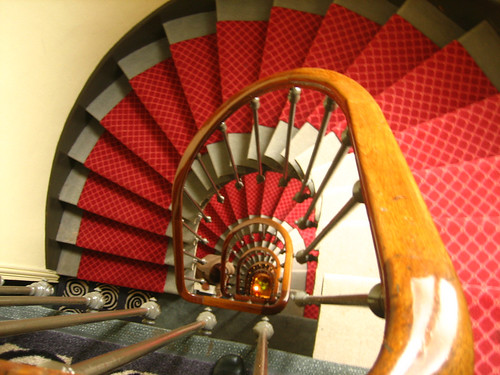
I lean out the window of our tiny room. To my right is Montparnasse tower, and directly below are sidewalk cafés.
"Let's go out and walk around," I say to Mr. Billy. I feel like I'm nine years old again, or twenty-one. I bounce on my toes. "Let's go see Paris."
And so we do.
Boy, was I wrong.
It starts the minute we leave the train station. I spy La Rotonde and the Café de Flore out the cab windows. It's all I can do to keep from squealing. Simone de Beauvoir and Sartre used to hang out here. We step out onto the narrow street and that old Paris smell - diesel exhaust and chocolate and a soft breath from somewhere above the buildings - spirals into my brain and sets the fireworks going.
We drag our bags behind us (the cab was unable to pull directly up to the hotel door) to our little hotel on the corner of the Rue d'Odessa. We learn later that this is where the finalists for "Nouvelle Star," the French version of "American Idol" are staying, but we would never have known: the place is small and sleepy. The desk clerks appear to be identical twins; one wears dark glasses. The elevator can only hold Mr. Billy with the bags, so I take the scenic route up the curling staircase.
I lean out the window of our tiny room. To my right is Montparnasse tower, and directly below are sidewalk cafés.
"Let's go out and walk around," I say to Mr. Billy. I feel like I'm nine years old again, or twenty-one. I bounce on my toes. "Let's go see Paris."
And so we do.
Saturday, July 12, 2008
You gotta get in where you fit in
To get to the main branch of the library from my doctor's office, I walk through the Tenderloin.
Past the legit theaters on Geary ('Tis a Pity She's a Whore, A Chorus Line, a one-man show about Shakespeare), then left on Hyde. It's morning still. A man walking toward me has a vivid bruise over his right eye, staining eyelid, brow, and all the way up to the top of his bald head. His toothless cheeks suck in against his gums.
Someone whistles behind me. I don't turn. They whistle again, and a skinny white guy at the next corner turns to grin past me. He raises a chin. A voice from behind me asks how his night went. The man across the street chuckles. The light changes, and I cross toward him, seeing the net of scars across his cheek and jaw. His hair stands out in tufts.
"You find your pot, huh?" the voice behind me calls.
He nods vaguely, grinning, and waves them off, crossing against the light. He heads toward the mini-park, a tiny green space tucked in among the buildings.
Ahead of me is a woman with bright blond hair hanging to her shoulders. She wears shining burgundy lycra tights under a tiny black miniskirt. A blue and green scarf is tied around one ankle, and she wobbles slightly in her green heels. I look for her face as we pass storefront windows, but all I can see are her big Jackie-O sunglasses.
At the library, volunteers are unloading books onto tables out front: "Linux for Dummies" and "Europe on $5 a Day." Passers-by gaze at the books, and the volunteers work silently.
On the front door is a notice - the library is closed until noon. It's a long time until noon.
I walk toward the Muni stop, disappointed. A man sitting on the library's low stone wall catches my eye. He looks big and healthy, and he smiles widely at me. He wears a knit cap with bright orange flames that stand out against his blue-black skin. It looks like a graphic representation of his thoughts.
"You gotta get in where you fit in," he says to me. "If you don't, that's it!"
I smile back at him and nod. The sun shines out from behind a cloud, and I head for my train.
Past the legit theaters on Geary ('Tis a Pity She's a Whore, A Chorus Line, a one-man show about Shakespeare), then left on Hyde. It's morning still. A man walking toward me has a vivid bruise over his right eye, staining eyelid, brow, and all the way up to the top of his bald head. His toothless cheeks suck in against his gums.
Someone whistles behind me. I don't turn. They whistle again, and a skinny white guy at the next corner turns to grin past me. He raises a chin. A voice from behind me asks how his night went. The man across the street chuckles. The light changes, and I cross toward him, seeing the net of scars across his cheek and jaw. His hair stands out in tufts.
"You find your pot, huh?" the voice behind me calls.
He nods vaguely, grinning, and waves them off, crossing against the light. He heads toward the mini-park, a tiny green space tucked in among the buildings.
Ahead of me is a woman with bright blond hair hanging to her shoulders. She wears shining burgundy lycra tights under a tiny black miniskirt. A blue and green scarf is tied around one ankle, and she wobbles slightly in her green heels. I look for her face as we pass storefront windows, but all I can see are her big Jackie-O sunglasses.
At the library, volunteers are unloading books onto tables out front: "Linux for Dummies" and "Europe on $5 a Day." Passers-by gaze at the books, and the volunteers work silently.
On the front door is a notice - the library is closed until noon. It's a long time until noon.
I walk toward the Muni stop, disappointed. A man sitting on the library's low stone wall catches my eye. He looks big and healthy, and he smiles widely at me. He wears a knit cap with bright orange flames that stand out against his blue-black skin. It looks like a graphic representation of his thoughts.
"You gotta get in where you fit in," he says to me. "If you don't, that's it!"
I smile back at him and nod. The sun shines out from behind a cloud, and I head for my train.
Friday, July 04, 2008
4th of July
Monday, June 30, 2008
My doctor ordered me to take a vacation
...a real vacation, he said. No obligations, no running around. A good, solid rest.
No problem, I said. I'm going to France.
A direct flight is entirely too expensive, so we fly through Montreal. Nine o'clock in the morning on Sunday, we are on our way to the airport. At security, Mr. Billy is pulled aside. Suspicious character, Mr. Billy. Shifty eyes and whatnot.
He walks away with an official airport security shoehorn in his pocket. Thanks, security guys!
Eight hours or so later, we're in Montreal, or so they tell us. It's French-language training wheels. We wander through the clean, modern airport, the Limbo of air travel. Duty Free, bars, restaurants, endless shining hallways.
We are stuffed into another metal tube with wings, shaken and buzzed and fed and movied for another seven hours or twelve hours or fifteen days. Plastic shades are lowered over oval windows, and some people sleep.
Sleep does not come for us.
We touch earth at last. Paris. My head rings, a long, sustained note.
The training wheels are off, now, and my brain struggles to come up with the language I once knew. Mr. Billy has no French, so it's all mine to fuck up.
We follow the signs to the train station, down in the belly of the airport. We're scheduled to meet my dad on the Côte d'Azur this evening. It's Monday afternoon, local time.
We find the station. Victory! Now, we need to buy train tickets. TGV - Very Big Fast - the bullet train south. There are kiosks and vending machines and counters and signs and signs and my brain rings and the words mean nothing. Like writing in dreams, the words shift and change the moment I think I've decoded them. I leave Mr. Billy with the bags while I try to find something I can understand.
There, a queue of people, a sign that says something like what I need, I can't even form the question in English. I stand in line and I am standing in line for a lifetime and then I'm at the front of it. I walk up to the man at the counter and try my thirty-years rusty French.
"Two tickets, if you please, for San Raphael. Or Frejus."
He answers me in English. The train leaves in half an hour. All is well.
"Don't leave me for so long, next time," says Mr. Billy when I return. He's been sitting here, prisoner with bags. No language, no idea where I am. I'm hungry and thirsty, but don't dare spend a single precious Euro cent. The train tickets were much more than we expected. I can't even process the exchange rate. We can't afford this trip, not even close. What was I thinking?
There are no drinking fountains.
It's all right, though, our train is coming. We find the correct platform, we know which car we need to board. It's assigned seating on the TGV. The train arrives, and we look for our car.
No, we're at the wrong end of the train. We run the length of the platform. The car numbers are going the wrong way. No, somehow we missed our car. The note sings in my head, and thoughts are slow to swim to the surface. We should just get on, somewhere, but I can't articulate the thought, can't act on it. We're running, dragging our suitcases. I can't even see a door that's open, all we need is an open door, but it's too late, all the doors close, we're running and the train is moving, pulling away.
I can't speak, French or English. I make a panicked face at the attendants on the platform. They shrug at me. What's the fuss, they say. There'll be another train in twenty minutes.
Okay, okay, twenty minutes. I can deal with that. I'd better see if I need to change our tickets, I say to Mr. Billy. I have to leave him alone again. Back up to the queue. The minutes are ticking away. I get to the counter just in time. The platform attendants lied. It's another three hours until the next train.
 We get to know the station very well. You have to pay to use the toilet. You have to pay for water you can drink. We sit, and we wait.
The train is twenty minutes late. We have to transfer in Marseilles. No problem; we have an hour between trains.
The train arrives thirty minutes late, and we get on the right car. We'll be all right now.
We watch the countryside out the window, but nothing sinks in. My ears sing. I'm tracking our progress on a map. The sun goes down. The next stop is Marseilles. It's dark outside, and the train slows, then stops. We look at the man across from us. He shrugs.
Some knocks. A clang. A loud report. A voice comes on the intercom. I can't understand these things in the U.S., let alone here. The announcer monologues. Clearly, it's quite a story. The man across from us looks at us for a moment.
"They don't know what's wrong," he says.
The process repeats. Knocks, clangs, the engine lurches, then silence. The voice monologues.
"They still don't know what's wrong," says our companion.
Again the ruckus, again the monologue. It's almost time for our transfer.
"They have no power," says the man across from us. He explains that we should still make our transfer - a lot of people are in the same boat, we just need to follow them.
The train begins to roll. The engine doesn't start up; they must have realized that there was enough of a slope to coast into the station. Softly as a dream, we pass graffitied walls and warehouses, and slide into the station.
We fall out of the train in the crush of bodies, dragging our corpse-suitcases. There are uniformed rail employees waiting on the platform.
"Transfer to St. Raphael?" I say, in French.
"Hurry!" says the rail worker. "It's leaving! Hurry up, hurry up!"
We step up the pace, rushing along with the crowd. The crowd rushes through the train station and out into the parking lot. Mr. Billy and I turn around, rushing back the way we came. There's the train, I see it now, we're running toward the train as it pulls away from the platform.
French comes flowing out of my mouth. I curse the rail worker eloquently.
"I told you to hurry," she says, shrugging.
"You didn't say where. Apparently that was too hard for you. Is your arm broken? Are you unable to point the way to the platform? I asked you about our transfer and all you said was hurry up. This was not helpful!"
She shrugs.
It's almost midnight, and we're in the Marseilles train station. The next train is tomorrow morning. I do what any grownup would do. I call Daddy.
"Don't worry," he says, "We'll pick you up."
It's more than an hour's drive, and my seventy-something-year-old Dad cheerfully suggests getting on the road at midnight to rescue us.
I find a bathroom (a pay bathroom, taking only coins, which requires me to buy water at McDonald's to get some change first), lock myself in the stall, and cry.
Mr. Billy is waiting out at the curb for me. We stare into the Marseilles night, nodding at the cat-sized rats that keep us company, and wait for Dad to arrive.
No problem, I said. I'm going to France.
A direct flight is entirely too expensive, so we fly through Montreal. Nine o'clock in the morning on Sunday, we are on our way to the airport. At security, Mr. Billy is pulled aside. Suspicious character, Mr. Billy. Shifty eyes and whatnot.
He walks away with an official airport security shoehorn in his pocket. Thanks, security guys!
Eight hours or so later, we're in Montreal, or so they tell us. It's French-language training wheels. We wander through the clean, modern airport, the Limbo of air travel. Duty Free, bars, restaurants, endless shining hallways.
We are stuffed into another metal tube with wings, shaken and buzzed and fed and movied for another seven hours or twelve hours or fifteen days. Plastic shades are lowered over oval windows, and some people sleep.
Sleep does not come for us.
We touch earth at last. Paris. My head rings, a long, sustained note.
The training wheels are off, now, and my brain struggles to come up with the language I once knew. Mr. Billy has no French, so it's all mine to fuck up.
We follow the signs to the train station, down in the belly of the airport. We're scheduled to meet my dad on the Côte d'Azur this evening. It's Monday afternoon, local time.
We find the station. Victory! Now, we need to buy train tickets. TGV - Very Big Fast - the bullet train south. There are kiosks and vending machines and counters and signs and signs and my brain rings and the words mean nothing. Like writing in dreams, the words shift and change the moment I think I've decoded them. I leave Mr. Billy with the bags while I try to find something I can understand.
There, a queue of people, a sign that says something like what I need, I can't even form the question in English. I stand in line and I am standing in line for a lifetime and then I'm at the front of it. I walk up to the man at the counter and try my thirty-years rusty French.
"Two tickets, if you please, for San Raphael. Or Frejus."
He answers me in English. The train leaves in half an hour. All is well.
"Don't leave me for so long, next time," says Mr. Billy when I return. He's been sitting here, prisoner with bags. No language, no idea where I am. I'm hungry and thirsty, but don't dare spend a single precious Euro cent. The train tickets were much more than we expected. I can't even process the exchange rate. We can't afford this trip, not even close. What was I thinking?
There are no drinking fountains.
It's all right, though, our train is coming. We find the correct platform, we know which car we need to board. It's assigned seating on the TGV. The train arrives, and we look for our car.
No, we're at the wrong end of the train. We run the length of the platform. The car numbers are going the wrong way. No, somehow we missed our car. The note sings in my head, and thoughts are slow to swim to the surface. We should just get on, somewhere, but I can't articulate the thought, can't act on it. We're running, dragging our suitcases. I can't even see a door that's open, all we need is an open door, but it's too late, all the doors close, we're running and the train is moving, pulling away.
I can't speak, French or English. I make a panicked face at the attendants on the platform. They shrug at me. What's the fuss, they say. There'll be another train in twenty minutes.
Okay, okay, twenty minutes. I can deal with that. I'd better see if I need to change our tickets, I say to Mr. Billy. I have to leave him alone again. Back up to the queue. The minutes are ticking away. I get to the counter just in time. The platform attendants lied. It's another three hours until the next train.
We get to know the station very well. You have to pay to use the toilet. You have to pay for water you can drink. We sit, and we wait.The train is twenty minutes late. We have to transfer in Marseilles. No problem; we have an hour between trains.
The train arrives thirty minutes late, and we get on the right car. We'll be all right now.
We watch the countryside out the window, but nothing sinks in. My ears sing. I'm tracking our progress on a map. The sun goes down. The next stop is Marseilles. It's dark outside, and the train slows, then stops. We look at the man across from us. He shrugs.
Some knocks. A clang. A loud report. A voice comes on the intercom. I can't understand these things in the U.S., let alone here. The announcer monologues. Clearly, it's quite a story. The man across from us looks at us for a moment.
"They don't know what's wrong," he says.
The process repeats. Knocks, clangs, the engine lurches, then silence. The voice monologues.
"They still don't know what's wrong," says our companion.
Again the ruckus, again the monologue. It's almost time for our transfer.
"They have no power," says the man across from us. He explains that we should still make our transfer - a lot of people are in the same boat, we just need to follow them.
The train begins to roll. The engine doesn't start up; they must have realized that there was enough of a slope to coast into the station. Softly as a dream, we pass graffitied walls and warehouses, and slide into the station.
We fall out of the train in the crush of bodies, dragging our corpse-suitcases. There are uniformed rail employees waiting on the platform.
"Transfer to St. Raphael?" I say, in French.
"Hurry!" says the rail worker. "It's leaving! Hurry up, hurry up!"
We step up the pace, rushing along with the crowd. The crowd rushes through the train station and out into the parking lot. Mr. Billy and I turn around, rushing back the way we came. There's the train, I see it now, we're running toward the train as it pulls away from the platform.
French comes flowing out of my mouth. I curse the rail worker eloquently.
"I told you to hurry," she says, shrugging.
"You didn't say where. Apparently that was too hard for you. Is your arm broken? Are you unable to point the way to the platform? I asked you about our transfer and all you said was hurry up. This was not helpful!"
She shrugs.
It's almost midnight, and we're in the Marseilles train station. The next train is tomorrow morning. I do what any grownup would do. I call Daddy.
"Don't worry," he says, "We'll pick you up."
It's more than an hour's drive, and my seventy-something-year-old Dad cheerfully suggests getting on the road at midnight to rescue us.
I find a bathroom (a pay bathroom, taking only coins, which requires me to buy water at McDonald's to get some change first), lock myself in the stall, and cry.
Mr. Billy is waiting out at the curb for me. We stare into the Marseilles night, nodding at the cat-sized rats that keep us company, and wait for Dad to arrive.
Saturday, May 31, 2008
Sudden fall, part 2
(Writing from a seaside villa in France. Life is grand, for you kind and hardy souls still reading. A break was called for, and a break this is. The story from before, however, continues...)
"I think I might've cracked a tooth," I say from the bathroom. I'm inspecting the damage to my face in the mirror. Not too bad. A scrape from the tip of my nose to my mouth. It jogs a bit to the right as it courses over my top lip. My boss will tell me later today it looks like the scar after harelip surgery.
Right now it just looks like I have a nosebleed.
A goose-egg is growing on my chin. It's already starting to bruise up.
I go back to the living room, where Mr. Billy is icing his foot with a bag of frozen peas. I get another bag and hold it to my face. I look over at Mr. Billy. "We're the disaster twins."
He tells me I shouldn't go in to work. I don't answer that. In only a few days, we'll be leaving the country for a three week vacation. There's just too much to do to miss a day.
I do, however, take time out to see the dentist.
"That's not a crack," she says, peering in (while I breathe out, relieved). "That's bits of sidewalk. I'll just buff it out."
My teeth appear to be intact, but there may be other damage. She can't tell - not even with x-rays - because of the swelling. I may have fractured my jaw.
"Soft food for a month," she says. Soft food? Is she crazy? I'm going to France! No crusty French bread?
"Just the soft, inside part."
Blecch.
On the bus back to work, I think of all the delicious soft French foods I can eat, while people's eyes slide off me. The bruise is in full bloom already. I feel like I'm wearing blinking lights on my face.
Eclairs, pot de creme, onion soup, pate.
Nobody wants to look at me. This isn't an insouciant, adventurous bruise. Something along the cheekbone, maybe, would speak of a branch in my way as I snowboarded down a pristine mountain.
Brie, chocolate mousse.
A bruise on the chin, a scrape on the mouth - on a woman's mouth - these are ugly. People see only bad crazy things that end up here. Somewhere out on the edge of sweaty half-dreams, where the money runs out, the addictions take over, that thing lives. That thing that most never ask themselves - How far can I fall and still live? A face like mine answers, Farther than you dare imagine.
Cafe au lait, I think. Ratatouille.
"I think I might've cracked a tooth," I say from the bathroom. I'm inspecting the damage to my face in the mirror. Not too bad. A scrape from the tip of my nose to my mouth. It jogs a bit to the right as it courses over my top lip. My boss will tell me later today it looks like the scar after harelip surgery.
Right now it just looks like I have a nosebleed.
A goose-egg is growing on my chin. It's already starting to bruise up.
I go back to the living room, where Mr. Billy is icing his foot with a bag of frozen peas. I get another bag and hold it to my face. I look over at Mr. Billy. "We're the disaster twins."
He tells me I shouldn't go in to work. I don't answer that. In only a few days, we'll be leaving the country for a three week vacation. There's just too much to do to miss a day.
I do, however, take time out to see the dentist.
"That's not a crack," she says, peering in (while I breathe out, relieved). "That's bits of sidewalk. I'll just buff it out."
My teeth appear to be intact, but there may be other damage. She can't tell - not even with x-rays - because of the swelling. I may have fractured my jaw.
"Soft food for a month," she says. Soft food? Is she crazy? I'm going to France! No crusty French bread?
"Just the soft, inside part."
Blecch.
On the bus back to work, I think of all the delicious soft French foods I can eat, while people's eyes slide off me. The bruise is in full bloom already. I feel like I'm wearing blinking lights on my face.
Eclairs, pot de creme, onion soup, pate.
Nobody wants to look at me. This isn't an insouciant, adventurous bruise. Something along the cheekbone, maybe, would speak of a branch in my way as I snowboarded down a pristine mountain.
Brie, chocolate mousse.
A bruise on the chin, a scrape on the mouth - on a woman's mouth - these are ugly. People see only bad crazy things that end up here. Somewhere out on the edge of sweaty half-dreams, where the money runs out, the addictions take over, that thing lives. That thing that most never ask themselves - How far can I fall and still live? A face like mine answers, Farther than you dare imagine.
Cafe au lait, I think. Ratatouille.
Saturday, May 24, 2008
Sudden fall, part 1
Two cars screech to a stop in the middle of the street. I watch the drivers jump out and run in my direction. This is interesting.
"Are you okay?"
"We saw you fall."
I'm on the ground, looking up at them. I just fell down, no big deal. A third person appears from somewhere behind me. I should probably get up, but it's not so bad, down here on the sidewalk.
I touch my face, and look at my fingers. Hm, blood. Maybe my nose is bleeding.
"Do you need a ride to the hospital?"
I look at the woman. It must have been a spectacular fall, to make her stop her car. I remember starting to fall, trying to catch myself. Taking giant steps, arms windmilling, all flapping limbs like Stan Laurel. My glasses are a couple of feet away. I pick them up and put them on. They aren't broken. Not even scratched.
"I just live right here, thanks," I say, gesturing vaguely behind me.
"Do you need help up the street?"
They really want to help. I thank them again. I'm just three steps from my front door. What was it the hobbit said? "It is a dangerous business going out your front door."
I find my keys, my purse, my book bag. I stand up. No problem. I unlock the door I just locked and walk inside.
"You're back," Mr. Billy calls from upstairs. He's laid up with a mashed foot.
"I fell down," I say, heading up the stairs. I sit down on the couch beside him. I'm sweating, and my vision starts to tunnel in. I put my head between my knees. Maybe I'll be a little late for work.
With my head between my knees, it occurs to me. This was a "sudden fall," a "drop attack," an "otolithic crisis of Tumarkin." Curse you, Tumarkin!
Let me back up.
Several weeks ago, I was tentatively diagnosed with Meniere's Disease. Dig the picture of the guy falling down. That's what happened to me, only I landed on my face instead of my ass.
I've been dealing with the whole Meniere's thing like the bowl of mush I am. Whining a lot. Hey, it's just dizziness. I should be able to deal with that. Had to change my diet, my work schedule, my sleep schedule. I can't drive anymore. That's all okay. I'm lucky to be able to make those adjustments.
But reading is difficult during a dizzy spell. This is not fair. Reading is the thing I do when I can't do anything else. When I was grounded as a kid, when I was recovering from surgeries, when I rode the bus, when I had to sit in a waiting room, I could always read. I'm a writer, dammit. If I can't read, I sure as hell can't write.
But drugs help. Diet helps. Reducing stress, reducing my workload - all of that helps. I was getting past the whining. Just the meat suit reminding me that my flesh outfit is me and I am it and we're in this thing together. All in all, it's a pretty good ensemble. My face fits me: kind of goofy-looking and friendly. I'm a decent dancer. I'm not especially tall or short or fat or skinny. Most of my parts work the way they should.
And then I fell down, and things got a little more interesting.
"Are you okay?"
"We saw you fall."
I'm on the ground, looking up at them. I just fell down, no big deal. A third person appears from somewhere behind me. I should probably get up, but it's not so bad, down here on the sidewalk.
I touch my face, and look at my fingers. Hm, blood. Maybe my nose is bleeding.
"Do you need a ride to the hospital?"
I look at the woman. It must have been a spectacular fall, to make her stop her car. I remember starting to fall, trying to catch myself. Taking giant steps, arms windmilling, all flapping limbs like Stan Laurel. My glasses are a couple of feet away. I pick them up and put them on. They aren't broken. Not even scratched.
"I just live right here, thanks," I say, gesturing vaguely behind me.
"Do you need help up the street?"
They really want to help. I thank them again. I'm just three steps from my front door. What was it the hobbit said? "It is a dangerous business going out your front door."
I find my keys, my purse, my book bag. I stand up. No problem. I unlock the door I just locked and walk inside.
"You're back," Mr. Billy calls from upstairs. He's laid up with a mashed foot.
"I fell down," I say, heading up the stairs. I sit down on the couch beside him. I'm sweating, and my vision starts to tunnel in. I put my head between my knees. Maybe I'll be a little late for work.
With my head between my knees, it occurs to me. This was a "sudden fall," a "drop attack," an "otolithic crisis of Tumarkin." Curse you, Tumarkin!
Let me back up.
Several weeks ago, I was tentatively diagnosed with Meniere's Disease. Dig the picture of the guy falling down. That's what happened to me, only I landed on my face instead of my ass.
I've been dealing with the whole Meniere's thing like the bowl of mush I am. Whining a lot. Hey, it's just dizziness. I should be able to deal with that. Had to change my diet, my work schedule, my sleep schedule. I can't drive anymore. That's all okay. I'm lucky to be able to make those adjustments.
But reading is difficult during a dizzy spell. This is not fair. Reading is the thing I do when I can't do anything else. When I was grounded as a kid, when I was recovering from surgeries, when I rode the bus, when I had to sit in a waiting room, I could always read. I'm a writer, dammit. If I can't read, I sure as hell can't write.
But drugs help. Diet helps. Reducing stress, reducing my workload - all of that helps. I was getting past the whining. Just the meat suit reminding me that my flesh outfit is me and I am it and we're in this thing together. All in all, it's a pretty good ensemble. My face fits me: kind of goofy-looking and friendly. I'm a decent dancer. I'm not especially tall or short or fat or skinny. Most of my parts work the way they should.
And then I fell down, and things got a little more interesting.
Friday, May 09, 2008
ping ping
Today I rode the train downtown. Morning train commuters are more self-contained than bus commuters. It's quiet, everyone in his own bubble. I stand all the way downtown.
It's a different crowd on the way back. Almost noon. A tall, thin woman sits beside me with her daughter. She is pregnant, but long and slender above and below her tidy, rounded belly. Clear-skinned, high cheekbones.
"I bet there won't be any kids there," the girl bumps her toes against the seat in front of her. Embroidery sparkles at the bottoms of her leggings.
"I bet there'll be a lot," says mom.
"I bet none," daughter sneaking a smile up at mom.
"I bet a lot! Look look, do you recognize it? There's the park."
They get off, whispering together, and mom's seat is taken by a stringy man in a beard. His jeans hang loose from his thighs.
He might be homeless, but I don't know for sure.
I look up at the next stop to see a transit cop standing at the front of the car.
"I need everybody to show me proof of payment. Ticket stub, fast pass."
She seems to have materialized in place. Full transit cop gear. Jacket, badge, heavy things strung from her belt.
The stringy man beside me bolts for the door, crossing directly in front of the transit cop. It's too late. The doors are closed, and he pings back and forth in the stairwell, pushing the door releases, palms open against the doors.
"You won't get out that way, sir," the transit cop says to him, softly. She doesn't want to bust a homeless man.
He's trapped, and he knows it. He buzzes past her again, toward the back of the car. She watches after him, then lifts a chin at the passenger closest to her. He shows his fast pass.
I lift out my pass, looking over my shoulder toward the back of the car. What can they do to a homeless guy? Normally it's a fine, but if someone doesn't have ID, doesn't have an address? It's not like she can arrest him, can she?
I can't see the stringy man, but I can hear him bumping up against each door of the car like a pinball. I imagine him fretting to the end of the car, pinned against the back door, heart thrumming in his chest.
It's a different crowd on the way back. Almost noon. A tall, thin woman sits beside me with her daughter. She is pregnant, but long and slender above and below her tidy, rounded belly. Clear-skinned, high cheekbones.
"I bet there won't be any kids there," the girl bumps her toes against the seat in front of her. Embroidery sparkles at the bottoms of her leggings.
"I bet there'll be a lot," says mom.
"I bet none," daughter sneaking a smile up at mom.
"I bet a lot! Look look, do you recognize it? There's the park."
They get off, whispering together, and mom's seat is taken by a stringy man in a beard. His jeans hang loose from his thighs.
He might be homeless, but I don't know for sure.
I look up at the next stop to see a transit cop standing at the front of the car.
"I need everybody to show me proof of payment. Ticket stub, fast pass."
She seems to have materialized in place. Full transit cop gear. Jacket, badge, heavy things strung from her belt.
The stringy man beside me bolts for the door, crossing directly in front of the transit cop. It's too late. The doors are closed, and he pings back and forth in the stairwell, pushing the door releases, palms open against the doors.
"You won't get out that way, sir," the transit cop says to him, softly. She doesn't want to bust a homeless man.
He's trapped, and he knows it. He buzzes past her again, toward the back of the car. She watches after him, then lifts a chin at the passenger closest to her. He shows his fast pass.
I lift out my pass, looking over my shoulder toward the back of the car. What can they do to a homeless guy? Normally it's a fine, but if someone doesn't have ID, doesn't have an address? It's not like she can arrest him, can she?
I can't see the stringy man, but I can hear him bumping up against each door of the car like a pinball. I imagine him fretting to the end of the car, pinned against the back door, heart thrumming in his chest.
Friday, February 29, 2008
I, who am your friend, will help you
The man sitting beside me on this morning's bus holds a small notepad; it fits in the palm of his hand. I glance away from my book to read what's written: English phrases, followed by Asian characters.
"Yes, I should like to come over."
"What time would suit you for my coming?"
The English is beautiful and formal, strangely contorted into correctness. Me and my dangling participles feel loose and jangly beside him.
The man looks like a character from a Kurosawa movie. Long, lined face. The honest farmer whose family has been brutalized. The salaryman who yearns for the forbidden. I peek to see more of the useful phrases he is learning.
"Do not bother yourself," his notepad reassures, "I, who am your friend, will help you."
This fills me with warmth, and gratitude. If he were my friend, and I was in need, I am sure he would help.
"Yes, I should like to come over."
"What time would suit you for my coming?"
The English is beautiful and formal, strangely contorted into correctness. Me and my dangling participles feel loose and jangly beside him.
The man looks like a character from a Kurosawa movie. Long, lined face. The honest farmer whose family has been brutalized. The salaryman who yearns for the forbidden. I peek to see more of the useful phrases he is learning.
"Do not bother yourself," his notepad reassures, "I, who am your friend, will help you."
This fills me with warmth, and gratitude. If he were my friend, and I was in need, I am sure he would help.
Sunday, January 27, 2008
En Wye See
Inside for two days. Rattling around hotel elevator, conference room, conference room, hotel room, conference room. PowerPoint slides and airconditioning that turns my fingernails blue. Up too late at night, unadjusted to East Coast time, getting up far too early, co-workers reflecting back bleary and hungover, some not appearing until afternoon.
Moving through the grand lobby, I spy daylight out there, but then it's back to another conference room for lunch and more sessions.
A couple of hours before the flight home, two precious hours, and I'm outside, stumbling onto the sidewalk blinking like a matinee moviegoer, surprisingly mild air - it's January! - my eyes wide, drinking in all the images I can't record in the camera I forgot to bring. Overtired, the whole thing happening a few paces removed from me, my head still rolling around an empty conference room, seeing New York City projected in a PowerPoint slide on the wall.
I trail behind co-workers up a broad set of stairs, library lions on either side. The doorman nods and a security guard peers into our purses, and deep into the library we go, ceilings high and stacks of books, but they would only tease - I'm too far from home with too little time to check out even one - instead we move in to the temporary display.
Running up the center of the room is a long glass case, a single yellow page running end to end, Kerouac's On The Road, all on one long page, so he wouldn't have to check the flow long enough to change out a page.
I don't usually dig stuff like this. Biographical stuff. Artistic process shit. I'm always comparing, thinking, if he didn't wash his socks until a manuscript was finished, maybe I shouldn't either. And the life isn't the art, anyway, the art is. This is why I don't read writer biographies. I'd rather just read what they wrote.
But it gets me. I'm crooking my neck to read - security guard scolding us about leaning on the glass - and I can see his cross-outs (not many), his dead-ends and wrong turns. I can see it was good right from the start, and he knew it.
And it doesn't make me feel small. I'm reading it and I'm waking up. It's okay, I think, it's an okay world where something like this is written, and remembered. Where a glass case is constructed so people can crook their necks and see, for a second, into somebody else's head.
It's time to head back to the hotel for my bags before being churned through the intestines of JFK and hurled home in the belly of a plane.
I nod at the security guard at the door, and breathe in some outside air on the front steps. Beside one of the lions is a delicate-boned young woman with a cane, black hair hanging to her hips. She turns to show a porcelain doll face, maybe Eurasian. I fall in love with her right there on the steps, watching her move fluidly, cane and all, and I'm glad. The girl with the cane, the guard at the door, the man eating his lunch on the library steps, the tourists. I'm in New York City, and it's alive and a hundred people jostle by, leaving little bits of themselves inside me.
Moving through the grand lobby, I spy daylight out there, but then it's back to another conference room for lunch and more sessions.
A couple of hours before the flight home, two precious hours, and I'm outside, stumbling onto the sidewalk blinking like a matinee moviegoer, surprisingly mild air - it's January! - my eyes wide, drinking in all the images I can't record in the camera I forgot to bring. Overtired, the whole thing happening a few paces removed from me, my head still rolling around an empty conference room, seeing New York City projected in a PowerPoint slide on the wall.
I trail behind co-workers up a broad set of stairs, library lions on either side. The doorman nods and a security guard peers into our purses, and deep into the library we go, ceilings high and stacks of books, but they would only tease - I'm too far from home with too little time to check out even one - instead we move in to the temporary display.
Running up the center of the room is a long glass case, a single yellow page running end to end, Kerouac's On The Road, all on one long page, so he wouldn't have to check the flow long enough to change out a page.
I don't usually dig stuff like this. Biographical stuff. Artistic process shit. I'm always comparing, thinking, if he didn't wash his socks until a manuscript was finished, maybe I shouldn't either. And the life isn't the art, anyway, the art is. This is why I don't read writer biographies. I'd rather just read what they wrote.
But it gets me. I'm crooking my neck to read - security guard scolding us about leaning on the glass - and I can see his cross-outs (not many), his dead-ends and wrong turns. I can see it was good right from the start, and he knew it.
And it doesn't make me feel small. I'm reading it and I'm waking up. It's okay, I think, it's an okay world where something like this is written, and remembered. Where a glass case is constructed so people can crook their necks and see, for a second, into somebody else's head.
It's time to head back to the hotel for my bags before being churned through the intestines of JFK and hurled home in the belly of a plane.
I nod at the security guard at the door, and breathe in some outside air on the front steps. Beside one of the lions is a delicate-boned young woman with a cane, black hair hanging to her hips. She turns to show a porcelain doll face, maybe Eurasian. I fall in love with her right there on the steps, watching her move fluidly, cane and all, and I'm glad. The girl with the cane, the guard at the door, the man eating his lunch on the library steps, the tourists. I'm in New York City, and it's alive and a hundred people jostle by, leaving little bits of themselves inside me.
Sunday, January 20, 2008
Amazon Breakthrough Novel Award
It's being a long winter here in Billyland, but a welcome ray of light has peeked through. My novel, Hoodoo, is a semi-finalist in the Amazon Breakthrough Novel Award.
I don't particularly believe in contests, and I'd completely forgotten I entered this one. But I gotta say, I'm tickled. This one's an interesting contest; it gives at least a portion of the power to the unwashed masses - you know, readers - in addition to the usual few who decide what makes it into print.
The novel will now get a full review from Publisher's Weekly (that would be the usual few), and is in the running for a publishing deal from Penguin.
But one of the factors that will decide whether Hoodoo makes it to the next level will be reviews from actual, real-life readers.
If you wanna have a say, go to my Amazon page, click the download button, and read the excerpt. Don't worry, it's a short excerpt. If you like what you read, write a glowing review. If you don't like it, write a nasty review. Write whatever you like! It's the Internets!
If you write a few good reviews, there may be something in it for you. According to Amazon: "The three customers who provide the most high quality reviews will be qualified to win one of three customer prizes, including an Amazon kindle reader, $2000 in Amazon gift card value, and an HP photo printer. Learn more at www.amazon.com/abna."
All in all, it's probably all about driving more traffic to Amazon's site so they can sell more stuff. The wheel turns and we all do our part.
But I still think it's pretty damn cool.
I don't particularly believe in contests, and I'd completely forgotten I entered this one. But I gotta say, I'm tickled. This one's an interesting contest; it gives at least a portion of the power to the unwashed masses - you know, readers - in addition to the usual few who decide what makes it into print.
The novel will now get a full review from Publisher's Weekly (that would be the usual few), and is in the running for a publishing deal from Penguin.
But one of the factors that will decide whether Hoodoo makes it to the next level will be reviews from actual, real-life readers.
If you wanna have a say, go to my Amazon page, click the download button, and read the excerpt. Don't worry, it's a short excerpt. If you like what you read, write a glowing review. If you don't like it, write a nasty review. Write whatever you like! It's the Internets!
If you write a few good reviews, there may be something in it for you. According to Amazon: "The three customers who provide the most high quality reviews will be qualified to win one of three customer prizes, including an Amazon kindle reader, $2000 in Amazon gift card value, and an HP photo printer. Learn more at www.amazon.com/abna."
All in all, it's probably all about driving more traffic to Amazon's site so they can sell more stuff. The wheel turns and we all do our part.
But I still think it's pretty damn cool.
Wednesday, December 26, 2007
A short yarn
I want to be hibernating. This is the time of year to hibernate. Yes, I live in California, but the northern bit of it. It gets dark before five p.m. That means hibernation.
But, no such luck. I must muster out of bed in the dark of the a.m. and make my way to work, then home again home again in the deep dark of a winter's eve. Normally, the bus commute is reading time. But when it's dark outside, my stomach lurches by the second block, and by the third I'm reaching for the bell, sweat pouring down my face and hands a-tremble.
So reading's out.
Somehow, though, knitting is fine. I can look up often enough to see where we're going, no sweats, no trembling, no dry heaves into the lap of my neighbor.
Tonight I pull my knitting from my bag as soon as I'm seated. I'm practiced at this by now, removing the stoppers from my needles, checking my pattern to see where I am, I settle the whole works in my lap, when I see my yarn isn't where it should be.
The red ball of yarn has escaped from my bag, and now it rolls quietly down the aisle of the bus.
The bus is in motion, my hands are full, the ball rolls, playing out the line that leads all the way back to my needles. I'm sitting near the back, and all I can do is watch its progress. It rolls neatly ahead, then dips to the side as the bus turns, then out again into the aisle, passengers one by one taking note as it passes, it's pointless to chase it down while we're moving: the yarn is nimble and light, I am an ox carrying panniers of water.
It rolls all the way to the front, at last coming to rest against a passenger's foot. It nudges at her instep like a kitten, but she doesn't see, doesn't feel its soft insistence until I rustle, lumber, clank to retrieve my prodigal yarn.
I murmur a sorry as I brush against her shoe to pick up my rebellious red ball, then scurry back to my place.
No - I correct myself: I murmur a sorry, barely holding in the guffaws that inflate my cheeks. I'm laughing, all the way, I'm delighted, and as I pass, the other passengers look up and into my eyes and share the joke.
I resume my seat, the whole bus shaking with silent laughter, those invisible walls between stranger and stranger dissolved for a moment, and I'm glad, finally, that I emerged from my cave today.
But, no such luck. I must muster out of bed in the dark of the a.m. and make my way to work, then home again home again in the deep dark of a winter's eve. Normally, the bus commute is reading time. But when it's dark outside, my stomach lurches by the second block, and by the third I'm reaching for the bell, sweat pouring down my face and hands a-tremble.
So reading's out.
Somehow, though, knitting is fine. I can look up often enough to see where we're going, no sweats, no trembling, no dry heaves into the lap of my neighbor.
Tonight I pull my knitting from my bag as soon as I'm seated. I'm practiced at this by now, removing the stoppers from my needles, checking my pattern to see where I am, I settle the whole works in my lap, when I see my yarn isn't where it should be.
The red ball of yarn has escaped from my bag, and now it rolls quietly down the aisle of the bus.
The bus is in motion, my hands are full, the ball rolls, playing out the line that leads all the way back to my needles. I'm sitting near the back, and all I can do is watch its progress. It rolls neatly ahead, then dips to the side as the bus turns, then out again into the aisle, passengers one by one taking note as it passes, it's pointless to chase it down while we're moving: the yarn is nimble and light, I am an ox carrying panniers of water.
It rolls all the way to the front, at last coming to rest against a passenger's foot. It nudges at her instep like a kitten, but she doesn't see, doesn't feel its soft insistence until I rustle, lumber, clank to retrieve my prodigal yarn.
I murmur a sorry as I brush against her shoe to pick up my rebellious red ball, then scurry back to my place.
No - I correct myself: I murmur a sorry, barely holding in the guffaws that inflate my cheeks. I'm laughing, all the way, I'm delighted, and as I pass, the other passengers look up and into my eyes and share the joke.
I resume my seat, the whole bus shaking with silent laughter, those invisible walls between stranger and stranger dissolved for a moment, and I'm glad, finally, that I emerged from my cave today.
Tuesday, December 18, 2007
This is my brain
According to credible reports, I am still here.

Not only that, my brain demonstrates no evidence for intraparenchymal signal abnormality.
The major intracranial signal voids are demonstrated, and the sagittal midline image demonstrates no evidence for pituitary mass or cerebellar tonsilar herniation.

To cap it all off, my ventricles and my sulci are age appropriate.

So I don't want to hear any more jokes about my immature sulci. Got it?

Not only that, my brain demonstrates no evidence for intraparenchymal signal abnormality.
The major intracranial signal voids are demonstrated, and the sagittal midline image demonstrates no evidence for pituitary mass or cerebellar tonsilar herniation.

To cap it all off, my ventricles and my sulci are age appropriate.

So I don't want to hear any more jokes about my immature sulci. Got it?
Sunday, December 02, 2007
Do I know you
He's just across the street from me as I'm waiting for the bus. He's focused intently on something in the gutter. He reaches both hands for it, carefully, stooping down, he scoops at empty air, gently gently handling nothing, bringing nothing close to his chest, cradling nothing tenderly, he steps around in a circle, letting nothing go, he begins all over again.
I can't take my eyes off him. What does he see? What is he holding with such delicacy? His hair hangs down over his face, I can't read his expression, but he performs these actions over and over, with variations: now he is cradling with both hands, now one hand holds while the other supports - what - a baby's head? Is he rescuing babies in the street? Or kittens?
Or something else, something of inestimable value? Something I can't - with all my busy-ness - begin to imagine?
He shakes his hair back, and I see his face for a few seconds. He smiles at whatever he holds. He looks like Viggo Mortensen, dirty face, long hair, beard. But his beard is trimmed. He wears a clean corduroy jacket - if slightly worn at the elbows - clean khakis. As he steps around in his turn, I see a wallet in his back pocket.
Who was he, before his doors of perception were thrown open, when he could tell the difference between the world Out There and the world In Here?
My bus comes, and I get on. It's time for me to be back at work, but I turn in my seat and watch him as we pull away. Do I know you?, I think. Do I know you?
I can't take my eyes off him. What does he see? What is he holding with such delicacy? His hair hangs down over his face, I can't read his expression, but he performs these actions over and over, with variations: now he is cradling with both hands, now one hand holds while the other supports - what - a baby's head? Is he rescuing babies in the street? Or kittens?
Or something else, something of inestimable value? Something I can't - with all my busy-ness - begin to imagine?
He shakes his hair back, and I see his face for a few seconds. He smiles at whatever he holds. He looks like Viggo Mortensen, dirty face, long hair, beard. But his beard is trimmed. He wears a clean corduroy jacket - if slightly worn at the elbows - clean khakis. As he steps around in his turn, I see a wallet in his back pocket.
Who was he, before his doors of perception were thrown open, when he could tell the difference between the world Out There and the world In Here?
My bus comes, and I get on. It's time for me to be back at work, but I turn in my seat and watch him as we pull away. Do I know you?, I think. Do I know you?
Sunday, November 11, 2007
A health care lesson
Recently, Bones asked what makes me pig-biting mad?
I have a wonderful nurse practitioner who has been my primary care physician for a few years now.
Correction: I had a wonderful nurse practitioner. Last week, she left private practice in order to work in public health. She's thrilled to be going back to her original focus - research & education - but here's the part that surprised even me (I'd considered myself well-informed about many of the health care issues in this country): working in public health instead of private practice, she will be making more money, getting better benefits, and working better hours.
"Really?" I said, astutely.
She went on to tell me how she was lucky to get the bare-bones benefits she had at the practice she was leaving. Many private practices, she said, don't offer benefits at all.
That five- or ten-dollar co-pay you make for your office visit? The practice depends on that to make payroll.
It's our beloved insurance companies who are making the money. Not the people who make us well when we're sick.
One thing I loved about seeing her was that she always seemed to have an appointment open when I was sick, and she always spent a generous amount of time with me. She listened to me, and she took the time to communicate clearly.
Apparently, she routinely got in trouble with the insurance company for vile, subversive behavior like this. In order to keep appointments available for people who were sick, she inevitably would have time slots that weren't filled. And this was a cardinal sin. The insurance company comes down hard on any practitioner who doesn't have every single time slot filled.
Good luck, then, getting an appointment when you're sick.
My wonderful nurse practitioner isn't an exception, either. More and more, brilliant and talented practitioners are leaving private practice in order to get out from under the thumb of insurance companies. They're leaving private practice, too, according to the dictates of the "free market": because they can make more money and get better benefits in public health than they can in private practice.
Allow me to repeat this: practitioners are leaving the private sector to work for the government so that they can earn more and have less interference from above.
Pig-spitting mad? That doesn't even begin to cover it.
I have a wonderful nurse practitioner who has been my primary care physician for a few years now.
Correction: I had a wonderful nurse practitioner. Last week, she left private practice in order to work in public health. She's thrilled to be going back to her original focus - research & education - but here's the part that surprised even me (I'd considered myself well-informed about many of the health care issues in this country): working in public health instead of private practice, she will be making more money, getting better benefits, and working better hours.
"Really?" I said, astutely.
She went on to tell me how she was lucky to get the bare-bones benefits she had at the practice she was leaving. Many private practices, she said, don't offer benefits at all.
That five- or ten-dollar co-pay you make for your office visit? The practice depends on that to make payroll.
It's our beloved insurance companies who are making the money. Not the people who make us well when we're sick.
One thing I loved about seeing her was that she always seemed to have an appointment open when I was sick, and she always spent a generous amount of time with me. She listened to me, and she took the time to communicate clearly.
Apparently, she routinely got in trouble with the insurance company for vile, subversive behavior like this. In order to keep appointments available for people who were sick, she inevitably would have time slots that weren't filled. And this was a cardinal sin. The insurance company comes down hard on any practitioner who doesn't have every single time slot filled.
Good luck, then, getting an appointment when you're sick.
My wonderful nurse practitioner isn't an exception, either. More and more, brilliant and talented practitioners are leaving private practice in order to get out from under the thumb of insurance companies. They're leaving private practice, too, according to the dictates of the "free market": because they can make more money and get better benefits in public health than they can in private practice.
Allow me to repeat this: practitioners are leaving the private sector to work for the government so that they can earn more and have less interference from above.
Pig-spitting mad? That doesn't even begin to cover it.
Wednesday, November 07, 2007
ESL
Time for some scratch fiction. Consider this a topic tag, too. If anyone wants to write on ESL - go! Let me know in the comments and I'll link to your story.
"Oh, my. Yes, it really looked so, um...he looked...what's the word..."
Eleanor tried to describe what she saw in her head with her hands, circling them around her head. Doug's boss nodded, smiling, a tiny clump of lipstick clinging to her front tooth. Doug's boss turned to answer somebody else's question and Doug squeezed Eleanor's knee under the table.
Eleanor was to be her best tonight. Charming. Brilliant. Dazzling. Doug's first dinner with the new company and she was on display.
But it chewed at her brain, while she sipped her wine. What was the word? She could see it, the man she was describing, backpack and coffe cup in one hand, books in another, reaching for his ringing cell phone. She saw it, but she couldn't think of the word to sum it up. Not silly. Not ridiculous. For some reason her brain threw up the plays of Samuel Becket, Ionesco. Waiting for Godot. Rhinoceros. What was it what was it?
Eleanor worked with words for a living. She didn't like to see one escape, a raw-muscled fish wriggling from her grasp.
"That's a lovely necklace," Doug's boss was talking to her again, "where did it come from?"
Eleanor touched her throat. "Thank you, it was a..." oh good lord you know this word, opening the wrapping, tied up in a ribbon..."um...from my mother." say something nice back, "your..." shit. Thing, the thing you wear to a formal dinner, Eleanor lightly touched Doug's boss' collar - was that strange? "...beautiful."
Doug's boss beamed. She touched her own collar, and started talking, and the words came from her mouth but seemed to drift somehow before they reached Eleanor's ears. What language was she speaking?
Doug spoke from Eleanor's side, the words colliding and cascading in front of Eleanor's eyes. It's like I'm forgetting my language, thought Eleanor, seeing foreign people sitting in a classroom, practicing words, what is it, what is my language called?
Eleanor smiled and nodded, watching the words pop out of Doug's boss' mouth like fat grapes, like shining ornaments, like puffs of flame, they lit up the room. Eleanor smiled at Doug, seeing images of him at his desk, Doug knocking on his boss' door, his eyes on his boss, his boss reaching across her desk to touch his arm once, twice, more, but she doesn't think "boss" "desk" "arm," she sees him, she sees her, she sees more than she's ever seen, more than she could wish.
Doug's boss turns to Eleanor and pushes out words that make a question, looking at Eleanor, but her breasts are looking at Doug and Eleanor opens her mouth, then closes it and smiles.
"Your wife is such a good listener," says Doug's boss, but Eleanor only sees the bright baubles falling from Doug's boss' mouth, her breasts looking at Doug and her thighs open and Doug and his cock nodding, nodding to his boss.
"Oh, my. Yes, it really looked so, um...he looked...what's the word..."
Eleanor tried to describe what she saw in her head with her hands, circling them around her head. Doug's boss nodded, smiling, a tiny clump of lipstick clinging to her front tooth. Doug's boss turned to answer somebody else's question and Doug squeezed Eleanor's knee under the table.
Eleanor was to be her best tonight. Charming. Brilliant. Dazzling. Doug's first dinner with the new company and she was on display.
But it chewed at her brain, while she sipped her wine. What was the word? She could see it, the man she was describing, backpack and coffe cup in one hand, books in another, reaching for his ringing cell phone. She saw it, but she couldn't think of the word to sum it up. Not silly. Not ridiculous. For some reason her brain threw up the plays of Samuel Becket, Ionesco. Waiting for Godot. Rhinoceros. What was it what was it?
Eleanor worked with words for a living. She didn't like to see one escape, a raw-muscled fish wriggling from her grasp.
"That's a lovely necklace," Doug's boss was talking to her again, "where did it come from?"
Eleanor touched her throat. "Thank you, it was a..." oh good lord you know this word, opening the wrapping, tied up in a ribbon..."um...from my mother." say something nice back, "your..." shit. Thing, the thing you wear to a formal dinner, Eleanor lightly touched Doug's boss' collar - was that strange? "...beautiful."
Doug's boss beamed. She touched her own collar, and started talking, and the words came from her mouth but seemed to drift somehow before they reached Eleanor's ears. What language was she speaking?
Doug spoke from Eleanor's side, the words colliding and cascading in front of Eleanor's eyes. It's like I'm forgetting my language, thought Eleanor, seeing foreign people sitting in a classroom, practicing words, what is it, what is my language called?
Eleanor smiled and nodded, watching the words pop out of Doug's boss' mouth like fat grapes, like shining ornaments, like puffs of flame, they lit up the room. Eleanor smiled at Doug, seeing images of him at his desk, Doug knocking on his boss' door, his eyes on his boss, his boss reaching across her desk to touch his arm once, twice, more, but she doesn't think "boss" "desk" "arm," she sees him, she sees her, she sees more than she's ever seen, more than she could wish.
Doug's boss turns to Eleanor and pushes out words that make a question, looking at Eleanor, but her breasts are looking at Doug and Eleanor opens her mouth, then closes it and smiles.
"Your wife is such a good listener," says Doug's boss, but Eleanor only sees the bright baubles falling from Doug's boss' mouth, her breasts looking at Doug and her thighs open and Doug and his cock nodding, nodding to his boss.
Tuesday, October 30, 2007
Quake that refreshes
Ka-boom-boom-boom-boom.
The flat started shaking as I was sharing a pomegranate with Mr. Billy. I had time to stare at Mr. Billy, think, "earthquake," put down the pomegranate, think, "damn, it's a long one."
And then it really got going.
BOOM-boom-BOOM-boom-boom.
We're looking around the flat for anything that might come flying off a shelf or a wall. We both stand up at the same time. Our black cat scrambles for her safe place under the bed.
Something crashes in the guest room.
The striped cat holds for dear life to his platform on the cat tree.
We stand ready for...something. Um, do we need to get under a doorway maybe?
I look at the picture behind the couch, swinging on the wall.
It stops. It doesn't wind down. It just stops. Mr. Billy moves quickly to me, puts his arms around me. We hold each other tightly, for a long time. He grins at me, his eyes big.
We take a minute to look around, see what fell. Nothing seems to be broken. We coo reassuringly at the cats, but it will be awhile before they've calmed down.
I'm putting away the leftovers, and it occurs to me: I'm happy.
Moments before I was Googling symptoms (note: do not do this. I can't stop myself, but you're better than me. Hint: whatever you have is cancer), checking work email, obsessing. Now I'm humming as I find a container for the pomegranate.
The seeds blink out at me like jewels.
The flat started shaking as I was sharing a pomegranate with Mr. Billy. I had time to stare at Mr. Billy, think, "earthquake," put down the pomegranate, think, "damn, it's a long one."
And then it really got going.
BOOM-boom-BOOM-boom-boom.
We're looking around the flat for anything that might come flying off a shelf or a wall. We both stand up at the same time. Our black cat scrambles for her safe place under the bed.
Something crashes in the guest room.
The striped cat holds for dear life to his platform on the cat tree.
We stand ready for...something. Um, do we need to get under a doorway maybe?
I look at the picture behind the couch, swinging on the wall.
It stops. It doesn't wind down. It just stops. Mr. Billy moves quickly to me, puts his arms around me. We hold each other tightly, for a long time. He grins at me, his eyes big.
We take a minute to look around, see what fell. Nothing seems to be broken. We coo reassuringly at the cats, but it will be awhile before they've calmed down.
I'm putting away the leftovers, and it occurs to me: I'm happy.
Moments before I was Googling symptoms (note: do not do this. I can't stop myself, but you're better than me. Hint: whatever you have is cancer), checking work email, obsessing. Now I'm humming as I find a container for the pomegranate.
The seeds blink out at me like jewels.
Tuesday, October 23, 2007
Burned-out husk
Post-rush-hour crowd on the bus as I ride to a doctor's appointment. An Asian man in a toupee sits across from me, Ken-doll swoop to his bangs. He holds his mouth pursed as though keeping in a mouthful of vomit. Or pearls.
I'm knitting, listening to the women behind me.
Mature Woman #1: Di-vis-a-der-o.
Mature Woman #2: That's a major street, there.
MW #1: So she asked me, are you carrying flame retardant with you when you drive? I mean, the car was just a burned-out husk, sitting in the driveway.
MW #3: Tsk.
No, it isn't quite a tsk. It's a sound I recognize, I've heard it before. Kind of a tsschp.
MW #1: Boat's completely gone. It was an old wooden boat, in the driveway. Nothing left. SUV's a burned-out husk.
MW #3: Tsschp.
Now I recognize the sound. My grandfather used to make that sound when he was sucking on his dentures, slurping the loose dentures back up against his gums.
MW #1: The firemen had to yell at Bob to stop, he was spraying down my car with the garden hose when they got there. Get away from there, they said, it could explode.
I'm eight years old again, listening to Gramps play guitar, jazzed up with a wah-wah pedal my uncle designed, and Gramps' own flourishes.
MW #1: You know, my little car didn't get any better mileage than that SUV.
MW #2: What'd it get?
MW #1: (mumbling) 16
MW #3: Tsschp.
Gramps played a fancy guitar, singing and playing and sucking up his dentures. Natty in his dark suit and string tie.
MW #2: Your car's not so little.
MW #1: It is. Not full-size.
My stop already. As I step down to the doors, I look back at the women. They each have a variation of the practical Mature Woman haircut. One gray, one blond, one brunette.
They wear matching, red-white-and-blue American flag windbreakers. The brunette shakes her map of San Francisco open for the other two to see.
I'm knitting, listening to the women behind me.
Mature Woman #1: Di-vis-a-der-o.
Mature Woman #2: That's a major street, there.
MW #1: So she asked me, are you carrying flame retardant with you when you drive? I mean, the car was just a burned-out husk, sitting in the driveway.
MW #3: Tsk.
No, it isn't quite a tsk. It's a sound I recognize, I've heard it before. Kind of a tsschp.
MW #1: Boat's completely gone. It was an old wooden boat, in the driveway. Nothing left. SUV's a burned-out husk.
MW #3: Tsschp.
Now I recognize the sound. My grandfather used to make that sound when he was sucking on his dentures, slurping the loose dentures back up against his gums.
MW #1: The firemen had to yell at Bob to stop, he was spraying down my car with the garden hose when they got there. Get away from there, they said, it could explode.
I'm eight years old again, listening to Gramps play guitar, jazzed up with a wah-wah pedal my uncle designed, and Gramps' own flourishes.
MW #1: You know, my little car didn't get any better mileage than that SUV.
MW #2: What'd it get?
MW #1: (mumbling) 16
MW #3: Tsschp.
Gramps played a fancy guitar, singing and playing and sucking up his dentures. Natty in his dark suit and string tie.
MW #2: Your car's not so little.
MW #1: It is. Not full-size.
My stop already. As I step down to the doors, I look back at the women. They each have a variation of the practical Mature Woman haircut. One gray, one blond, one brunette.
They wear matching, red-white-and-blue American flag windbreakers. The brunette shakes her map of San Francisco open for the other two to see.
Back by popular demand
(Popular demand = my sister and a friend)
Chuck has looked like a thumb for far too long. In mere moments, I hope to replace that vaguely repulsive image with a new one.
Chuck has looked like a thumb for far too long. In mere moments, I hope to replace that vaguely repulsive image with a new one.
Wednesday, July 18, 2007
Chuck looked like a thumb today
Waaay out of practice with the scratch fiction. Topic tag courtesy of monkey 0.
"No no no, it's really easy. You get a box like this, see? And you put a light inside."
"Right, they're attracted to light."
"And some bait. That's all it takes. Once you have enough in there, you drop the gate, and..."
Chuck jumped at the sound of the security gate slamming down, high-speed. "What the fuck?"
The chick over by the Twinkies jerked her head around to look at him, ponytail swooshing over one shoulder.
"Hello?" The dude had to be around here somewhere. "Um, guy? Anybody work here?"
Steve and Fayed appeared from the back of the store, Fayed humping a case of Miller. "What's with the gate?"
"Oh, dude, Miller? We can do better than that."
Fayed shrugged. "Is there like a fire or something? Maybe someone tripped a security switch."
Chuck looked over at the girl. She rolled her eyes like why-the-fuck-should-I-know. She put the Twinkies back on the shelf and pursed her lips. "Any of you work here?"
Chuck shook his head for the three of them.
"Yeah," said the chick. She shouldered past Chuck to get behind the counter and picked up the phone.
"Line's dead."
"You're shitting me."
She held the phone out to him, an exasperated sound popping out from between her lips. Short fuse. But that wasn't exactly a minus where Chuck was concerned. Especially not looking like that, all pissed.
Damn, thought Chuck. I look like a thumb today. Flesh-colored t-shirt and freshly shaved head. She must think I'm some kind of obscene joke.
Fayed was still holding onto the beer. Dipshit. "Put the beer down, Fed. Check and see if there's anyone in the bathroom."
Chuck turned back to the girl. Be still my heart, he thought. "Anything back there look like a control for the gate?"
She was searching around behind the counter, lovely brows shoved together in concentration. Fayed was walking back from the bathrooms, hands open. Nothing.
Steve ran over to the gate and started pounding. "Hey! People in here! HEY!"
"What's that thing?"
"Slushie machine. You have one of those, some beer, Funyons, you can get ten, fifteen in an hour, easy."
It took a while to calm Steve down. The idiot left Chuck's cell phone back at the place. And the chick - her name was Brenda - hers wasn't getting any signal. Shitty provider. She sat with her back against the counter playing with the ends of her hair. Her jeans held nice and tight around her ass, smooth neck lifting out of the collar of her sweater. Chuck imagined kissing her just below her earlobe, the down on her neck soft as kitten fur on his lips.
"Hey, they got playing cards here," Fayed held up a pack. Brenda shot him a look like no way in hell, but what else did they have to do? She lifted one shoulder and looked away while he shuffled.
A little too early to suggest strip poker, thought Chuck.
"They're just sitting around. They're not doing anything."
"Shake the box around some. That usually gets them all riled. Watch."
"No no no, it's really easy. You get a box like this, see? And you put a light inside."
"Right, they're attracted to light."
"And some bait. That's all it takes. Once you have enough in there, you drop the gate, and..."
Chuck jumped at the sound of the security gate slamming down, high-speed. "What the fuck?"
The chick over by the Twinkies jerked her head around to look at him, ponytail swooshing over one shoulder.
"Hello?" The dude had to be around here somewhere. "Um, guy? Anybody work here?"
Steve and Fayed appeared from the back of the store, Fayed humping a case of Miller. "What's with the gate?"
"Oh, dude, Miller? We can do better than that."
Fayed shrugged. "Is there like a fire or something? Maybe someone tripped a security switch."
Chuck looked over at the girl. She rolled her eyes like why-the-fuck-should-I-know. She put the Twinkies back on the shelf and pursed her lips. "Any of you work here?"
Chuck shook his head for the three of them.
"Yeah," said the chick. She shouldered past Chuck to get behind the counter and picked up the phone.
"Line's dead."
"You're shitting me."
She held the phone out to him, an exasperated sound popping out from between her lips. Short fuse. But that wasn't exactly a minus where Chuck was concerned. Especially not looking like that, all pissed.
Damn, thought Chuck. I look like a thumb today. Flesh-colored t-shirt and freshly shaved head. She must think I'm some kind of obscene joke.
Fayed was still holding onto the beer. Dipshit. "Put the beer down, Fed. Check and see if there's anyone in the bathroom."
Chuck turned back to the girl. Be still my heart, he thought. "Anything back there look like a control for the gate?"
She was searching around behind the counter, lovely brows shoved together in concentration. Fayed was walking back from the bathrooms, hands open. Nothing.
Steve ran over to the gate and started pounding. "Hey! People in here! HEY!"
"What's that thing?"
"Slushie machine. You have one of those, some beer, Funyons, you can get ten, fifteen in an hour, easy."
It took a while to calm Steve down. The idiot left Chuck's cell phone back at the place. And the chick - her name was Brenda - hers wasn't getting any signal. Shitty provider. She sat with her back against the counter playing with the ends of her hair. Her jeans held nice and tight around her ass, smooth neck lifting out of the collar of her sweater. Chuck imagined kissing her just below her earlobe, the down on her neck soft as kitten fur on his lips.
"Hey, they got playing cards here," Fayed held up a pack. Brenda shot him a look like no way in hell, but what else did they have to do? She lifted one shoulder and looked away while he shuffled.
A little too early to suggest strip poker, thought Chuck.
"They're just sitting around. They're not doing anything."
"Shake the box around some. That usually gets them all riled. Watch."
Wednesday, July 04, 2007
The blogger of the moment
Mr. Thing of the Moment was kind enough to travel far out of his way to meet me in an undisclosed location somewhere in Maine recently.

While Mr. K. is a real photographer with a fancy camera and the very expensive giant lens that captured every horrific detail of my bad hair day (whaddya want - I'd had an unexpected ride in a speedy and windy boat earlier that day), I was carrying my highly professional point-and-shoot:

But I didn't miss my chance to grab a photo of his terribly fashionable Chuck Taylor All-Stars, as well as a glimpse of his famous calves.


While Mr. K. is a real photographer with a fancy camera and the very expensive giant lens that captured every horrific detail of my bad hair day (whaddya want - I'd had an unexpected ride in a speedy and windy boat earlier that day), I was carrying my highly professional point-and-shoot:

But I didn't miss my chance to grab a photo of his terribly fashionable Chuck Taylor All-Stars, as well as a glimpse of his famous calves.

Monday, June 25, 2007
(Everybody's got something to hide except for)
Me and My Monkey (Part II)

Idexa agreed to take breaks so I could photograph our progress.

She worked for three hours.

I had a strong memory of my mother while Idexa's drill burred into my skin; one I hadn't thought of in years. She used to draw elaborate pictures on my feet. My favorite was a spiderweb that covered my foot and ran up the inside of my ankle, with a spider spinning away at the top.
"Do you like spiders?" Idexa asked.
"No," I said. In fact, both my mom and I were phobic. But somehow it was comforting, Mom lazily drawing the web as I lay back on her flowered quilt. She cradled my foot and we talked about nothing. I looked at my dad's painting that hung above their bed: a wingless angel flying overhead, cupping a palmful of light. If you fuzzed your eyes just a bit, though, it looked instead like the face of an old bearded man wearing goggles.

There it is, the finished product. You can say it - you know you're thinking it - I now have a monkey on my back.
Wednesday, June 20, 2007
The perfect beauty of the moist towelette
I am on a short flight from Boston to New York. We're past the solid layer of cloud over Boston, and below fluffs of white I can see green fields and black lakes. Little houses with bright blue-green swimming pools. Chlorine blue.
The stewardess who looks like Jackie Brown pours me a soft drink. She doesn't give me the whole can. She presses a white paper bag into my hand, her French manicure dragging across the paper.
I should have asked for the can.
I open the bag to the wonders inside. There are crackers shaped like butterflies. Cheese. Ranch dressing and a little baggie of tiny carrots. A fun-size Almond Joy. A white packet that tells me it contains a moist towelette. I can use this towelette, it informs me in serious black serif font, to clean and refresh my hands without soap and water.
Isn't there soap and water in the moist towelette?
I eat the cheese and crackers and drink my soft drink, wishing I had the whole can. I can't eat carrots or almonds. At first, the inside of my mouth would itch. Then my throat would swell until my breath was sealed off. I would flail for my Epipen dropping it on the floor. The plane would bank, sending my salvation rolling through the aisles as I slid off my seat and into oblivion on the industrial carpeting of a Delta shuttle.
If Mr. Billy were here, I would have offered him tiny carrots and Almond Joy. I would have watched doll fingers of orange disappear behind his white teeth. But Mr. Billy isn't here. The deadly snacks stay behind in the white paper bag.
We're out over water now.
I pull open the white packet containing the moist towelette and unfold it. It is thick and soft, not like the thin, papery towelettes I remember from Kentucky Fried Chicken in the days before it was KFC. In those days, they were wet-naps, bringing to mind visions of dirty diapers and drooly babies.
The Jackie Brown stewardess saunters lusciously down the aisle, checking that our seat backs are in the upright and locked position and our tray tables are closed. I see tall New York buildings below.
I take pleasure in the neat little rectangles created by the folds in the moist towelette. I wonder if the factory has a folding machine, or if a person folded this very towelette with her small hands.
The plane tilts at a very bad angle. Buildings that should be below are directly in front of me, above me. We are going to die in a screaming ball of fire. Me and a planeful of shining businessmen and -women in black suits.
I wrap the moist towelette gently over my hands, sliding it over my skin. I will go to my death with clean, refreshed hands.
The plane rights itself, and slides in to land, the wet-nap crumpled in the palm of my clean right hand.
No soap, no water.
The stewardess who looks like Jackie Brown pours me a soft drink. She doesn't give me the whole can. She presses a white paper bag into my hand, her French manicure dragging across the paper.
I should have asked for the can.
I open the bag to the wonders inside. There are crackers shaped like butterflies. Cheese. Ranch dressing and a little baggie of tiny carrots. A fun-size Almond Joy. A white packet that tells me it contains a moist towelette. I can use this towelette, it informs me in serious black serif font, to clean and refresh my hands without soap and water.
Isn't there soap and water in the moist towelette?
I eat the cheese and crackers and drink my soft drink, wishing I had the whole can. I can't eat carrots or almonds. At first, the inside of my mouth would itch. Then my throat would swell until my breath was sealed off. I would flail for my Epipen dropping it on the floor. The plane would bank, sending my salvation rolling through the aisles as I slid off my seat and into oblivion on the industrial carpeting of a Delta shuttle.
If Mr. Billy were here, I would have offered him tiny carrots and Almond Joy. I would have watched doll fingers of orange disappear behind his white teeth. But Mr. Billy isn't here. The deadly snacks stay behind in the white paper bag.
We're out over water now.
I pull open the white packet containing the moist towelette and unfold it. It is thick and soft, not like the thin, papery towelettes I remember from Kentucky Fried Chicken in the days before it was KFC. In those days, they were wet-naps, bringing to mind visions of dirty diapers and drooly babies.
The Jackie Brown stewardess saunters lusciously down the aisle, checking that our seat backs are in the upright and locked position and our tray tables are closed. I see tall New York buildings below.
I take pleasure in the neat little rectangles created by the folds in the moist towelette. I wonder if the factory has a folding machine, or if a person folded this very towelette with her small hands.
The plane tilts at a very bad angle. Buildings that should be below are directly in front of me, above me. We are going to die in a screaming ball of fire. Me and a planeful of shining businessmen and -women in black suits.
I wrap the moist towelette gently over my hands, sliding it over my skin. I will go to my death with clean, refreshed hands.
The plane rights itself, and slides in to land, the wet-nap crumpled in the palm of my clean right hand.
No soap, no water.
Saturday, June 09, 2007
(Everybody's got something to hide except for)
Me and My Monkey
"Billy, what have you been up to?" you might well ask. And I might answer:
"Getting a monkey on my back."
Shortly after my mother died, and my uterus was ripped out, I decided to get a tattoo. I'd avoided marking myself up for years, but with a newly-scarred body I figured I had nothing to lose. And it seemed a suitably twisted way to mark a pretty major year in my life.
That was two and a half years ago. I asked my father, an artist, to design my tattoo. In typical fashion for my family, it took me about a year to figure out what I wanted the tattoo to be. It took my dad another year and a half to start the design, and then he whipped it out in about an hour. We Billys raise procratination to an art form.
So, Dad's design was beautiful. But it wasn't right for my tattoo. So I found another design online.
Then I had to find the tattoo artist. I accosted illustrated strangers on the bus, in the pub, on the street. "Where did you get your work done?"
I surfed tattoo websites. I haunted tattoo parlors.
Finally, I found Idexa at Black & Blue Tattoo.
First we made an appointment to discuss the design. I brought her the design I'd found online, my dad's design, pictures of my dad's work. We made an appointment for a couple of weeks ahead to look over her design & make any final adjustments.
Then we made an appointment for the inking.

To be continued...
"Getting a monkey on my back."
Shortly after my mother died, and my uterus was ripped out, I decided to get a tattoo. I'd avoided marking myself up for years, but with a newly-scarred body I figured I had nothing to lose. And it seemed a suitably twisted way to mark a pretty major year in my life.
That was two and a half years ago. I asked my father, an artist, to design my tattoo. In typical fashion for my family, it took me about a year to figure out what I wanted the tattoo to be. It took my dad another year and a half to start the design, and then he whipped it out in about an hour. We Billys raise procratination to an art form.
So, Dad's design was beautiful. But it wasn't right for my tattoo. So I found another design online.
Then I had to find the tattoo artist. I accosted illustrated strangers on the bus, in the pub, on the street. "Where did you get your work done?"
I surfed tattoo websites. I haunted tattoo parlors.
Finally, I found Idexa at Black & Blue Tattoo.
First we made an appointment to discuss the design. I brought her the design I'd found online, my dad's design, pictures of my dad's work. We made an appointment for a couple of weeks ahead to look over her design & make any final adjustments.
Then we made an appointment for the inking.

To be continued...
Friday, June 08, 2007
The frenzy is catching
There is no reason this is a good idea. So what better reason to do it?
I blame monkey 0, because, why not? While I'm at it, I also blame monkey's hard-ass great-great-grandfather for not letting me make any excuses.
So. No excuses. I'm gonna try to write a script by June 30.
That is all.
I blame monkey 0, because, why not? While I'm at it, I also blame monkey's hard-ass great-great-grandfather for not letting me make any excuses.
So. No excuses. I'm gonna try to write a script by June 30.
That is all.
Wednesday, May 30, 2007
"No more to build on there."
Note: Thanks, everyone for your kind words. I get to go to a memorial service for my friend this weekend, where we'll talk about her and laugh and hug.
It's time, past time, to get back to the business of living.
"...And they, since they/Were not the one dead, turned to their affairs."
It's time, past time, to get back to the business of living.
"...And they, since they/Were not the one dead, turned to their affairs."
Saturday, May 05, 2007
Gone
A friend died yesterday. I don't know what to do with myself. I want to talk to people, to make connections, but it's her I want to be able to talk to. I want to ask her how it was for her, what was she thinking in those last few days, hours, what did she feel?
It's not an original observation, but the world is richer because she was in it.
It's not an original observation, but the world is richer because she was in it.
Monday, April 30, 2007
Caregiver
He swiped the towel over her mouth a little too abruptly, lines appearing briefly between her eyebrows, then gone, her eyes dull as buttons.
"Sorry, Honey," moving the towel more gently now, efficient as a nurse, as a professional caregiver. One who gives care, as opposed to one who simply cares.
She was an Amazon, once. A head taller than any other woman, and most of the men. Queen of the campus, students lining up outside her office like acolytes, her smile calming them, opening up pathways into their brains the way she'd opened him, until he felt the sun shining straight into his cerebral cortex, like a piece of skull missing, his brain vulnerable to any passing breeze.
Her hands lay empty on the bedspread, eyes closing, already sinking back into sleep.
She was rounded and full once, her hips rising under his hand, heat coming off her like a promise. The way she laughed with her whole face, those rich lips open, eyes screwed tight as flowers.
Her wrists are skinny now, light as matches. He traces her outline with two fingers, not touching, then straightens up. She needs her sleep, the laundry needs doing, the dishes washed, her next dose ready.
She said she was a real Amazon after surgery, the two of them touching the flattened space, the scar after it healed. She laughed and pushed her belly against his hand, kissing him hard and laughing.
He's almost to the door and feels a tickle at the back of his neck. He turns to see her looking at him, her mouth almost smiling. It's been days since she's spoken. He drops the laundry, and crouches down beside the bed, his head level with hers.
Her eyes seem fully conscious, looking at him. He hasn't been lover for a long time now. Not partner, either. He can stand up and walk away, play basketball, eat pizza. Make plans for the summer.
No, he's something else, something they share only with each other, more intimate than love. A connection runs between them, deep and wide as their bodies and the souls that hover near, and he wonders if he will see the moment when hers pulls loose, trailing its silver thread, its umbilical cord, pulling free of the womb of this world.
With apologies and love to John and Lynn; to Geo and her Gram.
"Sorry, Honey," moving the towel more gently now, efficient as a nurse, as a professional caregiver. One who gives care, as opposed to one who simply cares.
She was an Amazon, once. A head taller than any other woman, and most of the men. Queen of the campus, students lining up outside her office like acolytes, her smile calming them, opening up pathways into their brains the way she'd opened him, until he felt the sun shining straight into his cerebral cortex, like a piece of skull missing, his brain vulnerable to any passing breeze.
Her hands lay empty on the bedspread, eyes closing, already sinking back into sleep.
She was rounded and full once, her hips rising under his hand, heat coming off her like a promise. The way she laughed with her whole face, those rich lips open, eyes screwed tight as flowers.
Her wrists are skinny now, light as matches. He traces her outline with two fingers, not touching, then straightens up. She needs her sleep, the laundry needs doing, the dishes washed, her next dose ready.
She said she was a real Amazon after surgery, the two of them touching the flattened space, the scar after it healed. She laughed and pushed her belly against his hand, kissing him hard and laughing.
He's almost to the door and feels a tickle at the back of his neck. He turns to see her looking at him, her mouth almost smiling. It's been days since she's spoken. He drops the laundry, and crouches down beside the bed, his head level with hers.
Her eyes seem fully conscious, looking at him. He hasn't been lover for a long time now. Not partner, either. He can stand up and walk away, play basketball, eat pizza. Make plans for the summer.
No, he's something else, something they share only with each other, more intimate than love. A connection runs between them, deep and wide as their bodies and the souls that hover near, and he wonders if he will see the moment when hers pulls loose, trailing its silver thread, its umbilical cord, pulling free of the womb of this world.
With apologies and love to John and Lynn; to Geo and her Gram.
Monday, April 23, 2007
Monkey hats

A dear friend knitted monkey hats for the Billy family.

Blanche the cat models Mr. Billy's. Mr. Billy is camera shy, so Blanche is filling in.
What could be better than monkey hats?
Sunday, April 22, 2007
Butterfly
I share the bus with him most mornings. Had him pegged as a post-hippie: skinny, jeans-wearing ponytailed sort.
But on Friday, he climbed onto the bus, head ducking shyly. His hair was loose, brushed softly to his shoulders. His jeans, I noticed, were designer, fitting just so to his hips. A scarf ran through the belt loops. Hand lifting delicately to his sunglasses (glamorous Jackie O), I saw his fingernails shone, freshly manicured.
He pulled off his sunglasses, his eyes flicking from person to person around the bus. I smiled at him; he returned the smile, looking demurely down, mascaraed lashes casting shadows on his pinking cheeks.
But on Friday, he climbed onto the bus, head ducking shyly. His hair was loose, brushed softly to his shoulders. His jeans, I noticed, were designer, fitting just so to his hips. A scarf ran through the belt loops. Hand lifting delicately to his sunglasses (glamorous Jackie O), I saw his fingernails shone, freshly manicured.
He pulled off his sunglasses, his eyes flicking from person to person around the bus. I smiled at him; he returned the smile, looking demurely down, mascaraed lashes casting shadows on his pinking cheeks.
Thursday, April 12, 2007
I love the #22
Reasonably, my colleagues view the #22 bus with suspicion. It is noisy, crowded, smelly. Its route is through some of the worst sections of town.
But I love the #22.
I've ridden it in the middle of the workday when I'm leaving the office early, sick. When the riders are the gray-faced strung out; the bemused elderly; the leftover hippies, eyes following invisible spirits, hallucinatory bubbles as they rise toward the ceiling.
Early afternoon, and I'm elbowed by school kids shouting lusty from one end to the other, teeth sparking white in their greed to bite off chunks of life whole, to show us old folks their strength, their primacy. Weary-eyed teachers quiet near the front, an authoritative look from one momentarily lulls the kids.
But in the evening, oh, what a grand parade. In just a few blocks, on just one evening, I am treated to:
One cop near the front of the bus, bald as a lightbulb, talking with an elderly woman. I think she is Eastern European, possibly Baltic.
Two emaciated women, holding each other up. One white, one black. I cannot tell how old they are. They could be in their twenties or their forties, but the years have worked on them like the jaws of an animal. The white woman wears skinny jeans that nonetheless sag, fuscia thong showing above; the black woman a red leather skirt that outlines her curveless ass. Their eyes roll vaguely; I don't think they even see the cop as they sit directly across from him.
One Asian man in glasses, tall and slender as an alien, neatly dressed in buttery tweed. Matching vest buttoned top to bottom, soft gray tie like a pigeon's breast, pearl tie pin dimpling the perfect center.
At the third stop, a giant black man, head brushing the ceiling. Barbie-doll pink silk suit. Pink wingtips. Pink fedora. Pink cane. Full-length fur coat. He smiles, boarding the bus, the bald cop watching him pass, gold teeth winking.
Two lushly built black women sit together. The larger woman's jeans are laced up the side with ribbon; flawless brown flesh shining out between the laces. Over one bubbling breast is tattooed "PRINCESS". I can't read her other tattoos. The two of them are trying to offer a seat to an elderly Filipina, who shakes her bobbed hair merrily, "No, no, I'm okay." A passenger gets off, leaving the seat beside Princess empty, and the Filipina sits at last. Her eyes widen as she takes in Princess' body art.
"Oh," she says, delicately touching one tiny finger to Princess' shoulder, "You have pictures?"
"Tattoos."
"Oooooh," says Filipina, her eyes worried as she looks up at Princess, "It not hurt?"
Princess laughs. "Yeah, it hurt - but it's okay now."
I love the #22.
But I love the #22.
I've ridden it in the middle of the workday when I'm leaving the office early, sick. When the riders are the gray-faced strung out; the bemused elderly; the leftover hippies, eyes following invisible spirits, hallucinatory bubbles as they rise toward the ceiling.
Early afternoon, and I'm elbowed by school kids shouting lusty from one end to the other, teeth sparking white in their greed to bite off chunks of life whole, to show us old folks their strength, their primacy. Weary-eyed teachers quiet near the front, an authoritative look from one momentarily lulls the kids.
But in the evening, oh, what a grand parade. In just a few blocks, on just one evening, I am treated to:
One cop near the front of the bus, bald as a lightbulb, talking with an elderly woman. I think she is Eastern European, possibly Baltic.
Two emaciated women, holding each other up. One white, one black. I cannot tell how old they are. They could be in their twenties or their forties, but the years have worked on them like the jaws of an animal. The white woman wears skinny jeans that nonetheless sag, fuscia thong showing above; the black woman a red leather skirt that outlines her curveless ass. Their eyes roll vaguely; I don't think they even see the cop as they sit directly across from him.
One Asian man in glasses, tall and slender as an alien, neatly dressed in buttery tweed. Matching vest buttoned top to bottom, soft gray tie like a pigeon's breast, pearl tie pin dimpling the perfect center.
At the third stop, a giant black man, head brushing the ceiling. Barbie-doll pink silk suit. Pink wingtips. Pink fedora. Pink cane. Full-length fur coat. He smiles, boarding the bus, the bald cop watching him pass, gold teeth winking.
Two lushly built black women sit together. The larger woman's jeans are laced up the side with ribbon; flawless brown flesh shining out between the laces. Over one bubbling breast is tattooed "PRINCESS". I can't read her other tattoos. The two of them are trying to offer a seat to an elderly Filipina, who shakes her bobbed hair merrily, "No, no, I'm okay." A passenger gets off, leaving the seat beside Princess empty, and the Filipina sits at last. Her eyes widen as she takes in Princess' body art.
"Oh," she says, delicately touching one tiny finger to Princess' shoulder, "You have pictures?"
"Tattoos."
"Oooooh," says Filipina, her eyes worried as she looks up at Princess, "It not hurt?"
Princess laughs. "Yeah, it hurt - but it's okay now."
I love the #22.
Wednesday, April 11, 2007
Back in the saddle
So to speak. I have a loaner laptop glowing reassuringly at me now. More bloggy goodness to come.
Thursday, March 29, 2007
No words
I don't have any words today. I see lovely, glowing comments on my posts, and no words bubble up to equal those shining things.
I don't have any words this week. Strange things have been afoot around my workplace: lurching stomachs, family tragedies, a full leg cast. The sound of clashing metal brought a few of us to the windows that face the street. A semi had cut a corner too close, smashing into one parked car that shoved into another. Cars and crooked semi lounging uselessly below our office windows. With resigned looks at each other we shrug, only to be expected this week.
I don't have any words tonight. Mr. Billy gallantly giving up his chair before the computer so I could work on the book, and nothing. I look at the page and want to vomit. Not words. Dinner maybe, then lunch, then old cans and boots and dust bunnies and a disheveled cat. But no words, no words.
I don't have any words this week. Strange things have been afoot around my workplace: lurching stomachs, family tragedies, a full leg cast. The sound of clashing metal brought a few of us to the windows that face the street. A semi had cut a corner too close, smashing into one parked car that shoved into another. Cars and crooked semi lounging uselessly below our office windows. With resigned looks at each other we shrug, only to be expected this week.
I don't have any words tonight. Mr. Billy gallantly giving up his chair before the computer so I could work on the book, and nothing. I look at the page and want to vomit. Not words. Dinner maybe, then lunch, then old cans and boots and dust bunnies and a disheveled cat. But no words, no words.
Friday, March 23, 2007
It could be Tom Waits
Blogger apologies: my old laptop went tits-up again, so I am far behind in my posting and in reading yours. It's not because I don't love you, whatever those other bloggers might say.
Mr. Billy and I are snug into bed; it's already well past my bedtime, and I'm reeling from a beer and two glasses of wine downed at a friend's book party at City Lights (yes, I'm a cheap date).
My head settles in to sleep, street sounds drifting in through the window. There's a party going down in the neighborhood, but I'm working it into my dreams, people laughing and talking, cars passing by, it's all good, already looping dreamishly, but then someone brings out a guitar.
I groan. "Someone out there with a guitar and a mouth," I say to Mr. Billy. He's still awake, I can tell from the quiet breaths, controlled shifting under the covers.
We turn over, in opposite directions, burrowing into the pillows. The song follows, stealing into my consciousness.
"Hey," I lift my head, "I know that song. It's the Heart of Saturday Night."
"Hunh?" Maybe Mr. Billy wasn't as wakeful as I'd thought.
"Tom Waits song." It was that Waitsian couplet that tipped me off, Tell me is the crack of the poolballs, neon buzzin?/Telephone's ringin'; it's your second cousin, I'm listening now for the next stanza.
"Maybe it is Tom Waits."
I start to laugh, but stop right away. It's plausible. Tom Waits used to live in this neighborhood. His favorite café is just down the street.
I'm sitting up in bed now, straining to hear. It doesn't really sound like him, but sound distorts traveling across a street, through window glass. It could be Tom Waits. I get up and put on my glasses, moving from window to window. The party's in the house that's obscured by a blossoming tree. I can't tell.
Mr. Billy's up now, too. He's opening the kitchen window and putting his head out. I'm out on the back lanai.
"It's a woman singing now."
We get back into bed.
"It could have been him."
We turn over, in opposite directions, punching at the pillows. We're quiet for a moment.
"What if it is him?" I say, then close my mouth. We should go to sleep.
They're singing up a storm at that party.
Mr. Billy gets up, and starts getting dressed.
"I'll call you if it's him," he says, heading out the door. I love Mr. Billy.
He's back in ten minutes.
"Nothing?"
"A bunch of hippies. And a cellist."
Maybe it's the Kronos Quartet, I think. They live in this neighborhood.
I don't say anything.
Mr. Billy and I are snug into bed; it's already well past my bedtime, and I'm reeling from a beer and two glasses of wine downed at a friend's book party at City Lights (yes, I'm a cheap date).
My head settles in to sleep, street sounds drifting in through the window. There's a party going down in the neighborhood, but I'm working it into my dreams, people laughing and talking, cars passing by, it's all good, already looping dreamishly, but then someone brings out a guitar.
I groan. "Someone out there with a guitar and a mouth," I say to Mr. Billy. He's still awake, I can tell from the quiet breaths, controlled shifting under the covers.
We turn over, in opposite directions, burrowing into the pillows. The song follows, stealing into my consciousness.
"Hey," I lift my head, "I know that song. It's the Heart of Saturday Night."
"Hunh?" Maybe Mr. Billy wasn't as wakeful as I'd thought.
"Tom Waits song." It was that Waitsian couplet that tipped me off, Tell me is the crack of the poolballs, neon buzzin?/Telephone's ringin'; it's your second cousin, I'm listening now for the next stanza.
"Maybe it is Tom Waits."
I start to laugh, but stop right away. It's plausible. Tom Waits used to live in this neighborhood. His favorite café is just down the street.
I'm sitting up in bed now, straining to hear. It doesn't really sound like him, but sound distorts traveling across a street, through window glass. It could be Tom Waits. I get up and put on my glasses, moving from window to window. The party's in the house that's obscured by a blossoming tree. I can't tell.
Mr. Billy's up now, too. He's opening the kitchen window and putting his head out. I'm out on the back lanai.
"It's a woman singing now."
We get back into bed.
"It could have been him."
We turn over, in opposite directions, punching at the pillows. We're quiet for a moment.
"What if it is him?" I say, then close my mouth. We should go to sleep.
They're singing up a storm at that party.
Mr. Billy gets up, and starts getting dressed.
"I'll call you if it's him," he says, heading out the door. I love Mr. Billy.
He's back in ten minutes.
"Nothing?"
"A bunch of hippies. And a cellist."
Maybe it's the Kronos Quartet, I think. They live in this neighborhood.
I don't say anything.
Wednesday, March 07, 2007
Not a fire this time
I'm sautéeing vegetables for dinner, standing in the kitchen, Mr. Billy & I talking - about what is lost now, but Mr. Billy was mid-sentence - when a heavy metal scrape and crunch break in from outside. It's just a step to the window, and I see a black SUV. The driver's standing so hard on the gas it leans forward on its shocks, the wheels' friction holding it back a fraction of a second before letting go with a long screech, and it disappears down the street.
I don't see the other vehicle at first; it's a white mini-van up on the curb, less than four feet from the corner of our building. Mr. Billy slides open the window.
"Are you okay?" he calls.
Already neighbors are gathering. I'm ready to call the cops, but I see a cell phone flip open down there on the street.
"My cousin was killed by a hit and run," I say. It's the first thing that pops into my head.
Mr. Billy's already on his way down the stairs. I stay long enough to make sure the stove is off, and follow him out into the spitting rain.
The driver of the white mini-van is hysterical, her mouth wide open, wailing behind the steering wheel. Her door is open, and she has one foot out on the runner board. She doesn't appear to be hurt.
Several people are standing around, leaning into the car to talk to her, lighting up cigarettes, talking. One of them is talking to Mr. Billy, looking familiar.
"Hey, look who lives here," says Mr. Billy.
It's N., an old acquaintance of ours; he moved into the house across the street six months ago and we didn't know until just now. He hugs me and we laugh. I look over at the hysterical woman and my laughter tails off. She isn't slowing down, waves and waves of loud sobs, mouth stretched wide like a jack o'lantern.
"You got the license?" Mr. Billy is saying, and I'm impressed, someone managed to get the plate number that fast, but that isn't it. One of the neighbors is holding something in his hand.
Not the number, the actual license plate.
"Yeah," he says, laughing, "it broke off when he hit her. I saw it land in the street."
"Fuck YEAH," says someone else.
I imagine the driver's sick feeling when he realizes his plate's gone. It feels good. I have revenge in mind right now, crowing at his stupidity, oh, he'll get his tonight.
The hysterical woman is still howling. I lean in, ask her if she wants to come inside where it's warm, but she shakes her head, still sobbing, thrashing at the tears with her fists. She doesn't seem to speak much English.
"I tried to speak Chinese with her," says N., "but I think she only speaks Cantonese."
The hysterical woman's phone starts to chime. She opens it, holds it to her head, howls into it. Finally the howls turn into words, but she hasn't calmed down. She closes the phone and settles back into her sobs, rocking slightly in her seat.
"She lives right up the street," says a woman. She and the man with her live a few blocks away; they were driving home when they saw the accident, and they tried to chase the black SUV, but it pulled away too quickly.
Everyone goes quiet, and we look at the driver of the white mini-van.
"She's hysterical."
"Maybe we should call back, get an ambulance here."
"An ambulance will come anyway, won't it?"
"No, she said she didn't want an ambulance."
"I'm calling."
I introduce myself to the couple who tried to chase the SUV. We shake hands. We look at the mini-van driver. I crouch down next to her. I'm trying to figure out how to ask her if she needs anything, a blanket, a drink of water. She shakes her head, rocking, crying.
"How long before the cops get here, do you think?"
"Man, is she okay?"
"She's, it's the shock, you know? It's a shock."
"Yeah, I guess so."
Finally, a police cruiser rolls quietly toward us.
"Police," I say to the woman, pointing.
"Thank you," she says, then opens her mouth to howl some more.
The cop speaks Cantonese. Another car pulls up. We tell what we saw, what we heard. They run the plate. None of us saw the driver of the other car, none of us can describe him. Or her. I tell one of the cops where to find us if they need anything else, and we go inside where it's warm and dry.
I'm finishing dinner, and Mr. Billy looks out the window.
"Her husband's there," he says, "they're hugging."
I don't see the other vehicle at first; it's a white mini-van up on the curb, less than four feet from the corner of our building. Mr. Billy slides open the window.
"Are you okay?" he calls.
Already neighbors are gathering. I'm ready to call the cops, but I see a cell phone flip open down there on the street.
"My cousin was killed by a hit and run," I say. It's the first thing that pops into my head.
Mr. Billy's already on his way down the stairs. I stay long enough to make sure the stove is off, and follow him out into the spitting rain.
The driver of the white mini-van is hysterical, her mouth wide open, wailing behind the steering wheel. Her door is open, and she has one foot out on the runner board. She doesn't appear to be hurt.
Several people are standing around, leaning into the car to talk to her, lighting up cigarettes, talking. One of them is talking to Mr. Billy, looking familiar.
"Hey, look who lives here," says Mr. Billy.
It's N., an old acquaintance of ours; he moved into the house across the street six months ago and we didn't know until just now. He hugs me and we laugh. I look over at the hysterical woman and my laughter tails off. She isn't slowing down, waves and waves of loud sobs, mouth stretched wide like a jack o'lantern.
"You got the license?" Mr. Billy is saying, and I'm impressed, someone managed to get the plate number that fast, but that isn't it. One of the neighbors is holding something in his hand.
Not the number, the actual license plate.
"Yeah," he says, laughing, "it broke off when he hit her. I saw it land in the street."
"Fuck YEAH," says someone else.
I imagine the driver's sick feeling when he realizes his plate's gone. It feels good. I have revenge in mind right now, crowing at his stupidity, oh, he'll get his tonight.
The hysterical woman is still howling. I lean in, ask her if she wants to come inside where it's warm, but she shakes her head, still sobbing, thrashing at the tears with her fists. She doesn't seem to speak much English.
"I tried to speak Chinese with her," says N., "but I think she only speaks Cantonese."
The hysterical woman's phone starts to chime. She opens it, holds it to her head, howls into it. Finally the howls turn into words, but she hasn't calmed down. She closes the phone and settles back into her sobs, rocking slightly in her seat.
"She lives right up the street," says a woman. She and the man with her live a few blocks away; they were driving home when they saw the accident, and they tried to chase the black SUV, but it pulled away too quickly.
Everyone goes quiet, and we look at the driver of the white mini-van.
"She's hysterical."
"Maybe we should call back, get an ambulance here."
"An ambulance will come anyway, won't it?"
"No, she said she didn't want an ambulance."
"I'm calling."
I introduce myself to the couple who tried to chase the SUV. We shake hands. We look at the mini-van driver. I crouch down next to her. I'm trying to figure out how to ask her if she needs anything, a blanket, a drink of water. She shakes her head, rocking, crying.
"How long before the cops get here, do you think?"
"Man, is she okay?"
"She's, it's the shock, you know? It's a shock."
"Yeah, I guess so."
Finally, a police cruiser rolls quietly toward us.
"Police," I say to the woman, pointing.
"Thank you," she says, then opens her mouth to howl some more.
The cop speaks Cantonese. Another car pulls up. We tell what we saw, what we heard. They run the plate. None of us saw the driver of the other car, none of us can describe him. Or her. I tell one of the cops where to find us if they need anything else, and we go inside where it's warm and dry.
I'm finishing dinner, and Mr. Billy looks out the window.
"Her husband's there," he says, "they're hugging."
Subscribe to:
Posts (Atom)
